When people find out that you grow your own food their typical response is that it is a “nice hobby” and/or that “you can buy it cheaper in the store” and/or that “it takes up so much time”. Although I was not able to rebuke them and had to agree that it can take time to care for a garden, it boils down to priorities. And for me, being able to know where my food came from was important. But is it cheaper to grow my own was the question. So in 2023 I decided to find out. But realizing that every year can be different, I decided to continue with the data collection and analysis in 2024 to determine if growing my own food does save me money or not.
As I outlined in Does Gardening Save Me Money - A Year In Review there are many benefits to gardening such as time spent outdoors, exercise and being able to go outside my door to “shop” the garden. But the main reasons for me having a garden is that I know where my food comes from and that I really like having to not shop the stores. I also believed that the garden saved me money. A fact that in 2023 was not true in the food forest orchard garden as I identified in Establishing a Food Forest Orchard Garden - But Will it Save Me Money but was true in my main crop garden. Overall, in 2023, with the $2,098.42 CDN ($1,549.73 USD) savings realized from the main crop garden over purchasing in-store and the $1,608.68 CDN ($1,181.26 USD) loss experienced in the Food Forest Orchard Garden compared to in- store purchasing, the 2023 gardening year still realized an overall savings of $489.74CDN ($368.47 USD). But what would 2024 show?
2024 Garden study context
Although I followed the basic context of the 2023 study to weigh everything that was harvested from the gardens, this year I decided to group the main crop garden, the raised beds and the food forest orchard garden for an overall costing and harvest number. There is some benefit to having each garden separate and in the future I may do so again. But for 2024, a total garden year analysis from all sources was undertaken. I was also more diligent about recording the time I spent weeding, harvesting, watering and the like.
As I mentioned in Does Gardening Save Me Money - A Year In Review, my production type gardens and raised beds total about 5,000 sq ft (464.5 sq m). Additionally, the food forest orchard garden, established in 2024, and documented in Establishing a Food Forest Orchard Garden - But Will it Save Me Money totals about 1,000 sq ft (92.9 sq m). Although I am increasing the gardens, currently these two spaces give me about 6,000 sq ft (557.4 sq m) in which to grow food.
Because I have a number of perennial vegetables in the gardens, the garden started producing even before I got the beds prepared and/or annual plants put in. Things like a bumper crop of Asparagus was harvested on May 30.
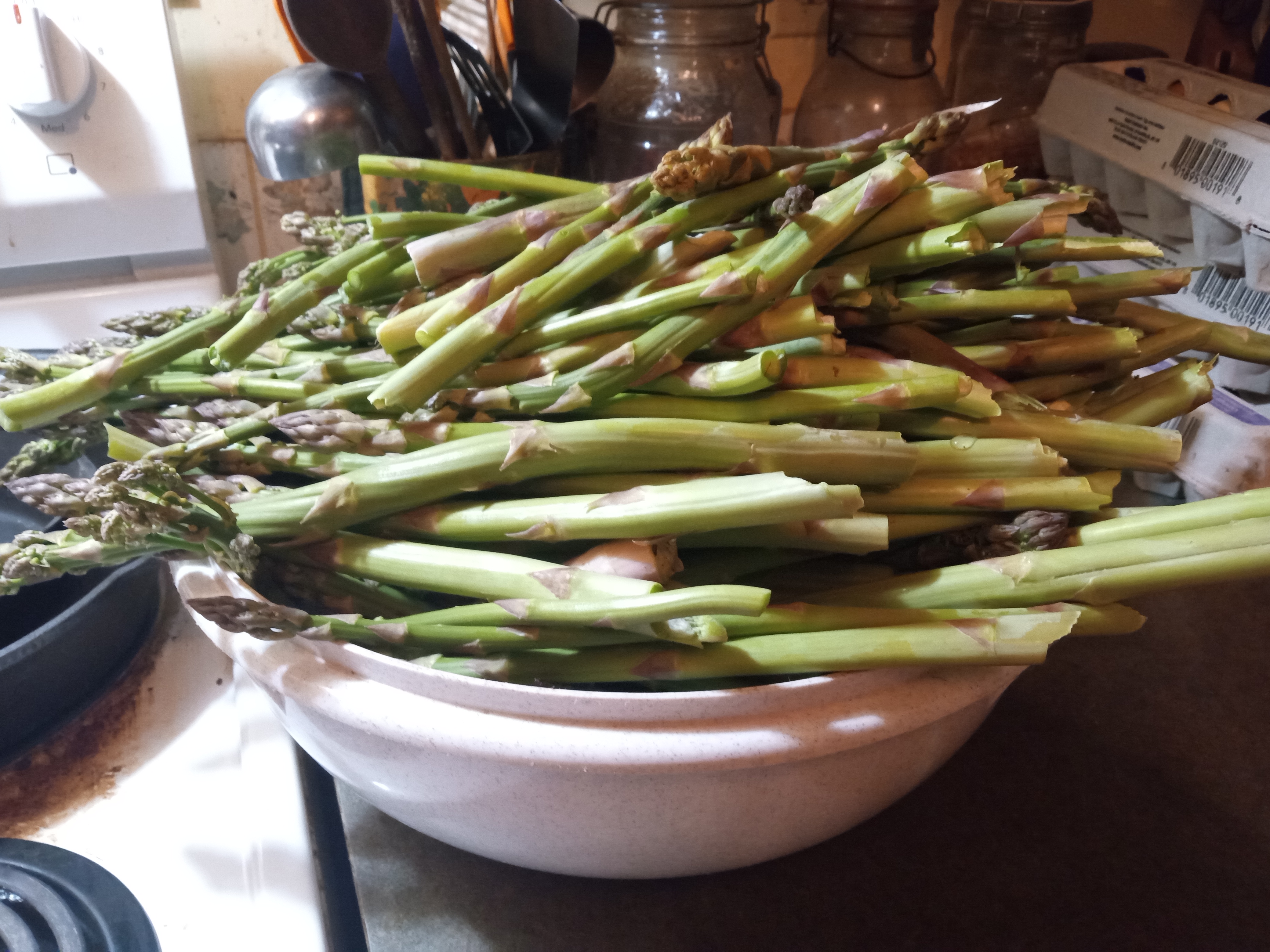
So while I was enjoying the early spring harvest and foraging around the yard as I did in Wild food foraging of edible wild greens for supper, the main gardens sat dormant except for weeds. Not uncommon from years previous but where the main difference lies from last year is when I got the garden planted. In these parts, the majority of folks want the garden planted by May 20 or June 1 at the latest. But I have typically bucked that a bit and despite the opinion that if you don't have your garden in by May 20 you are wasting your time, I have done well despite getting the garden in as late as June 14. And in 2024, it was even later because I did not start planting the food forest orchard garden until June 14 and the main crop garden until June 24 with completion on June 28. With the cold wet May and June we had, I was in no rush to plant. And to be honest, I guess one could say my heart wasn't in it. I had the mantra of "it will be what it will be".
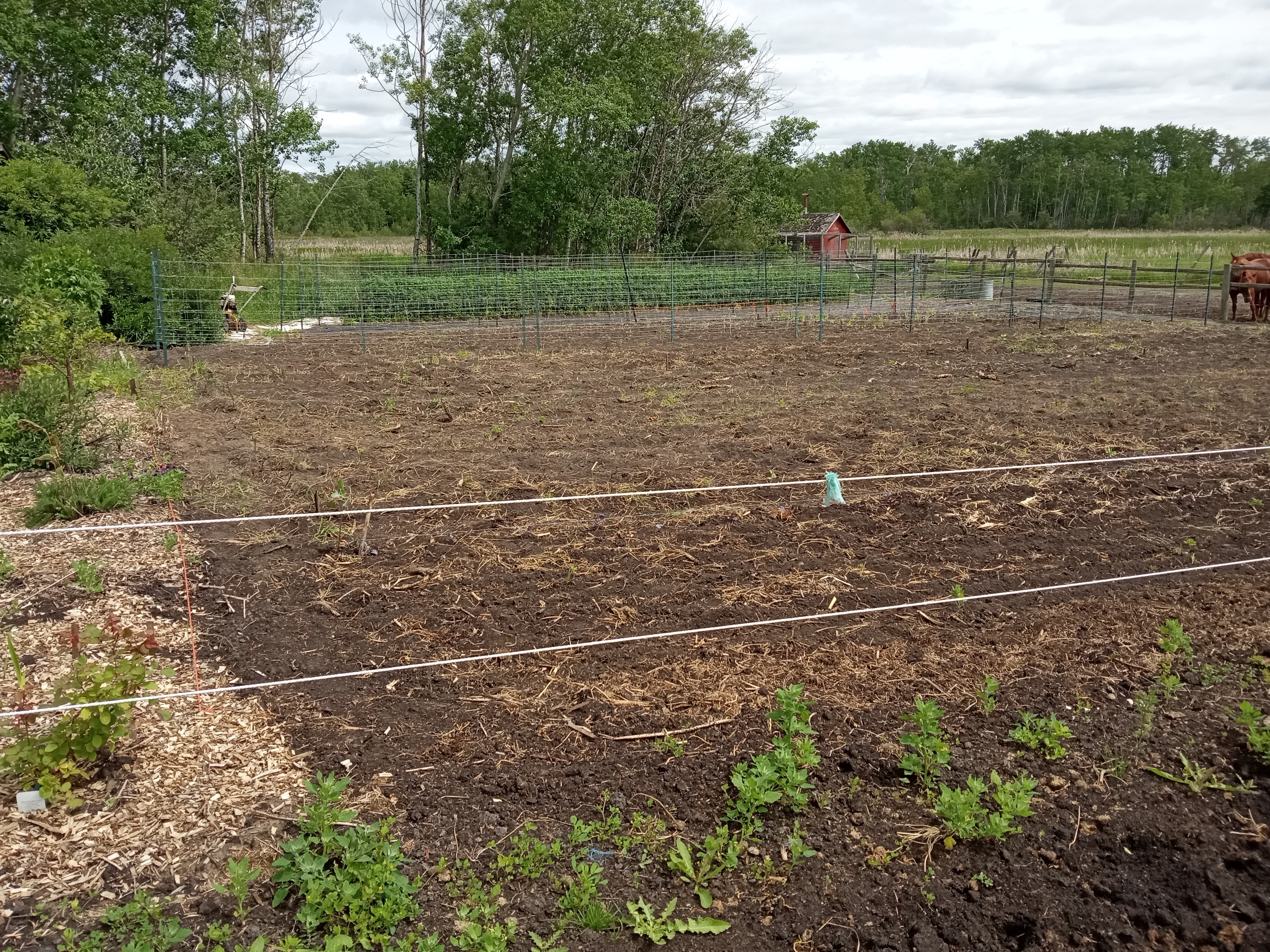
However, despite my poor attitude, with the extra moisture and warm soil, once planted the gardens were quick to germinate and start growing. With the exception of the poor germination of the carrots, parsnips beans and peas, it wasn't long before everything was up and getting ready to start growing strong and by July 11 things were up and growing, including the weeds.
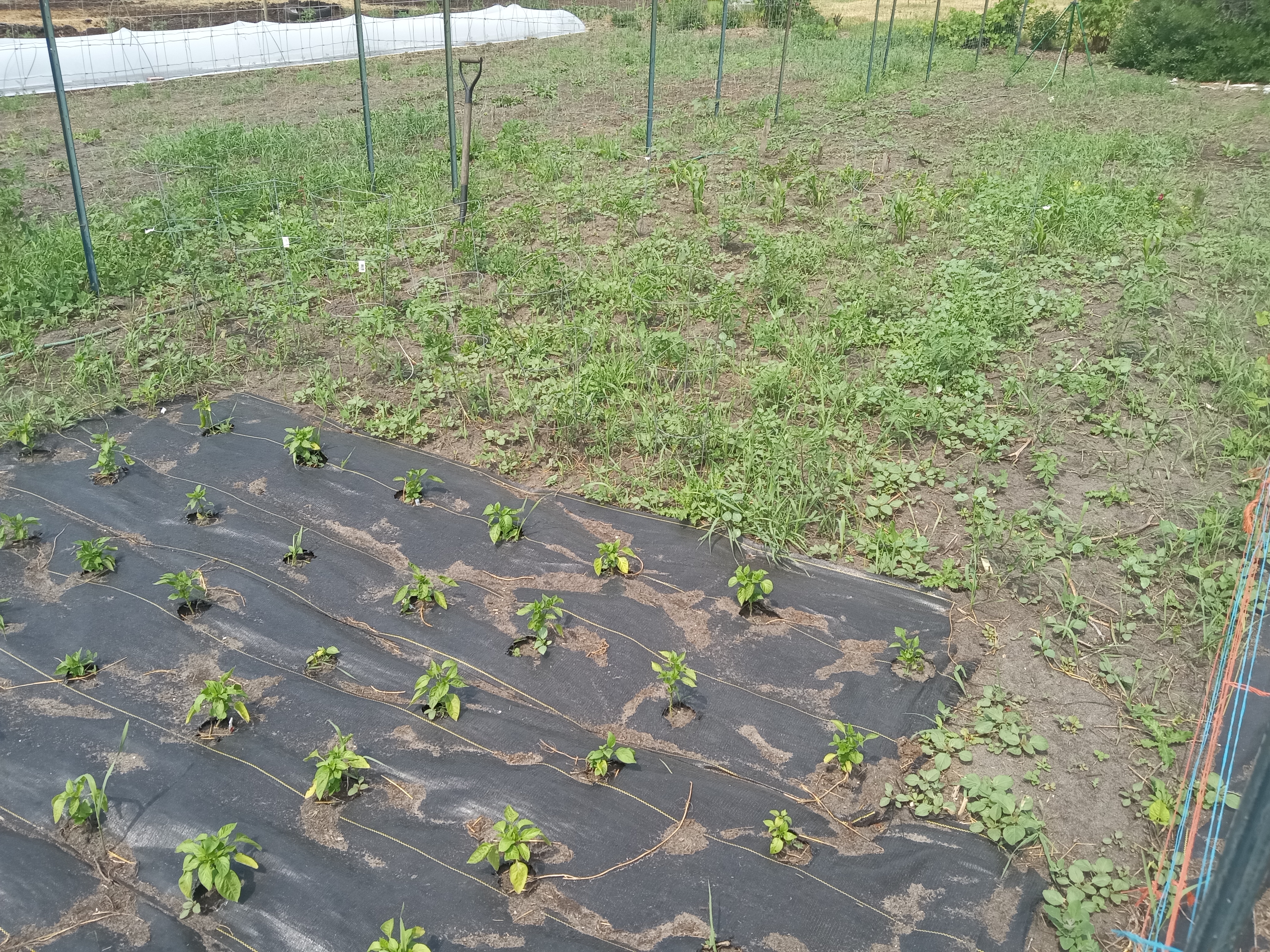
With the dry weather that followed, watering the main crop garden from the dugout was a regular occurrence and by August 1 the garden was looking great. And interestingly enough, going through the motions of watering and weeding, the gardens that once energized me each spring eventually did so again, just a little later than normal.
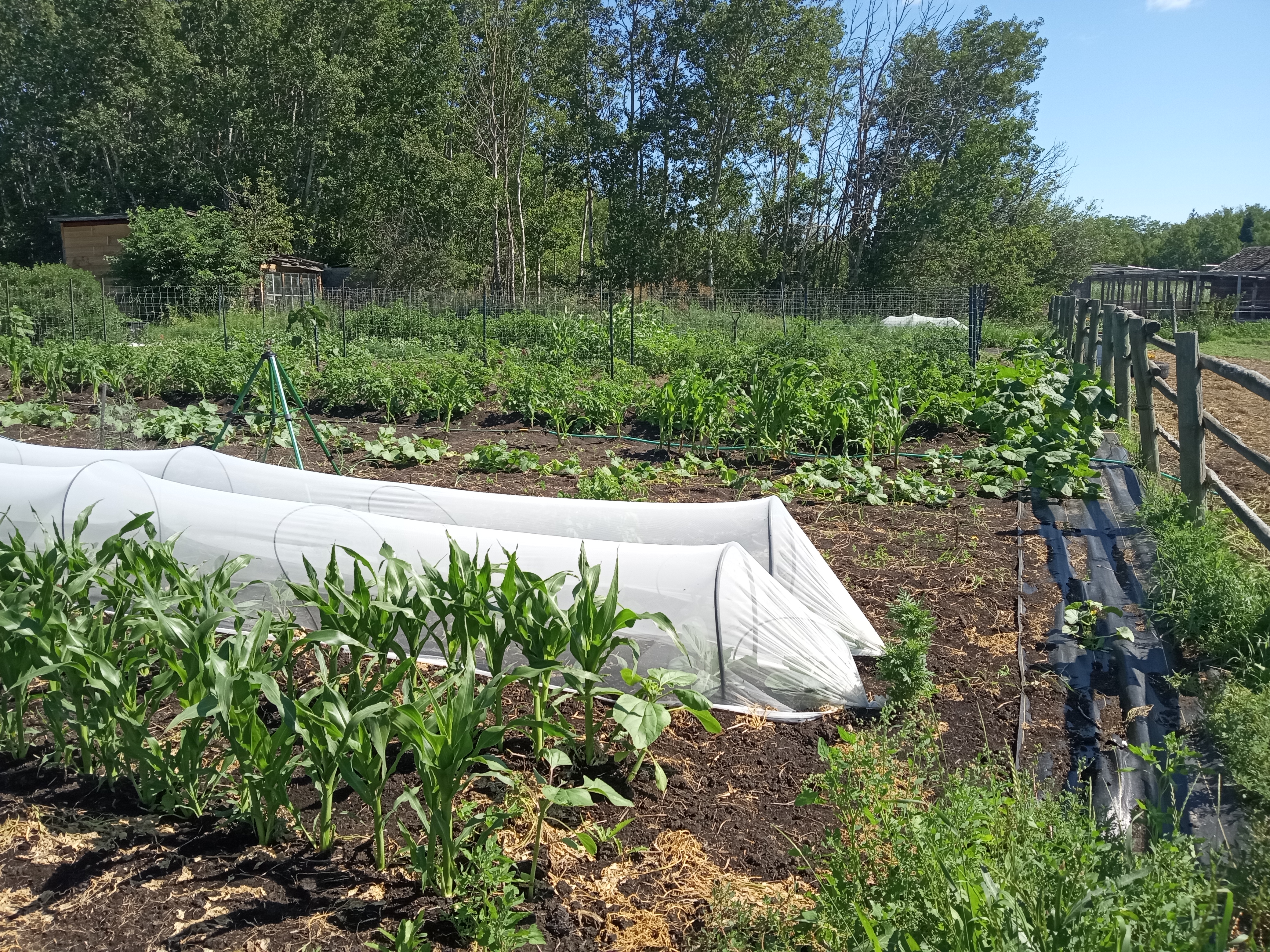
The food forest orchard garden was doing really well.
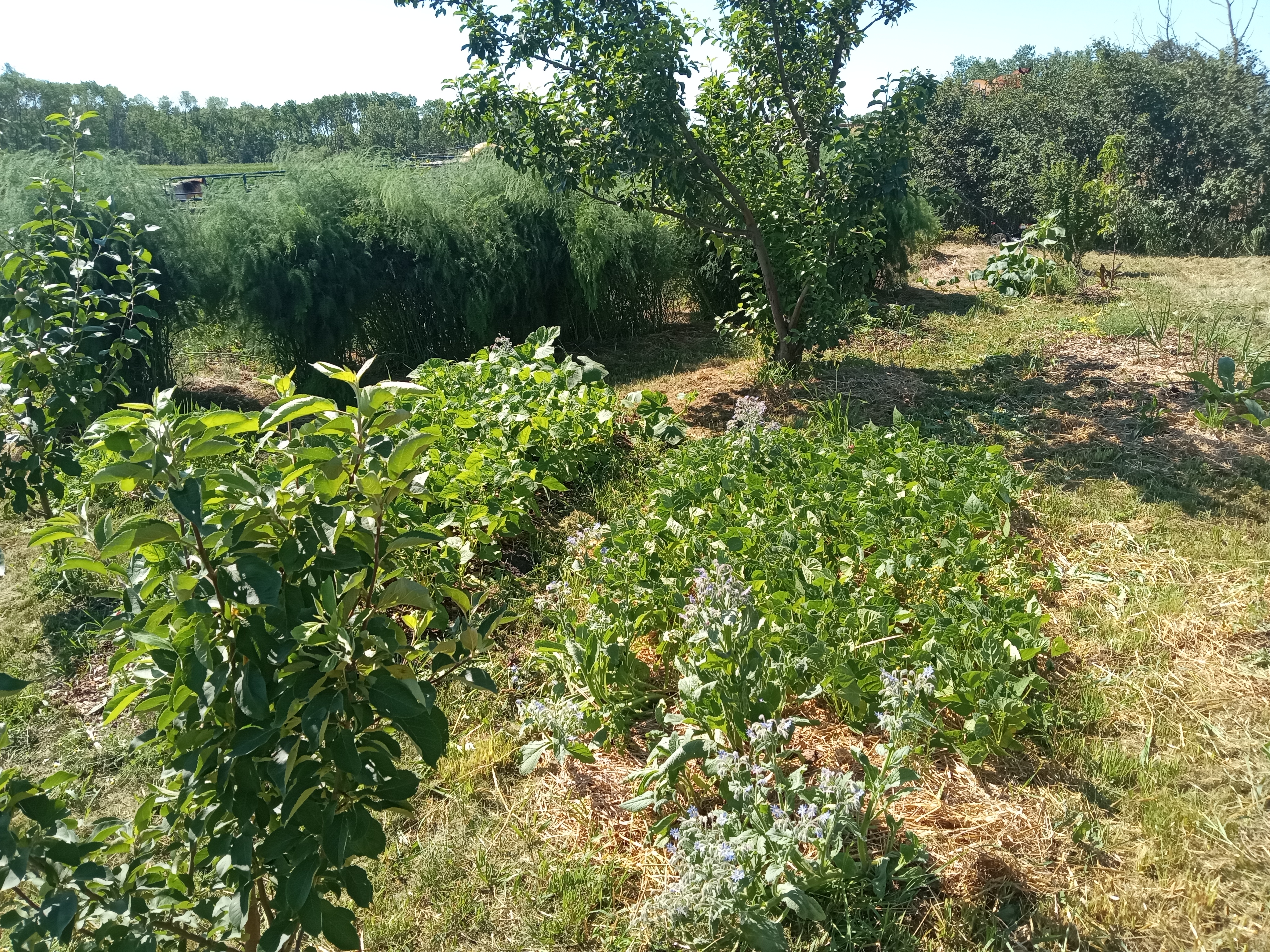
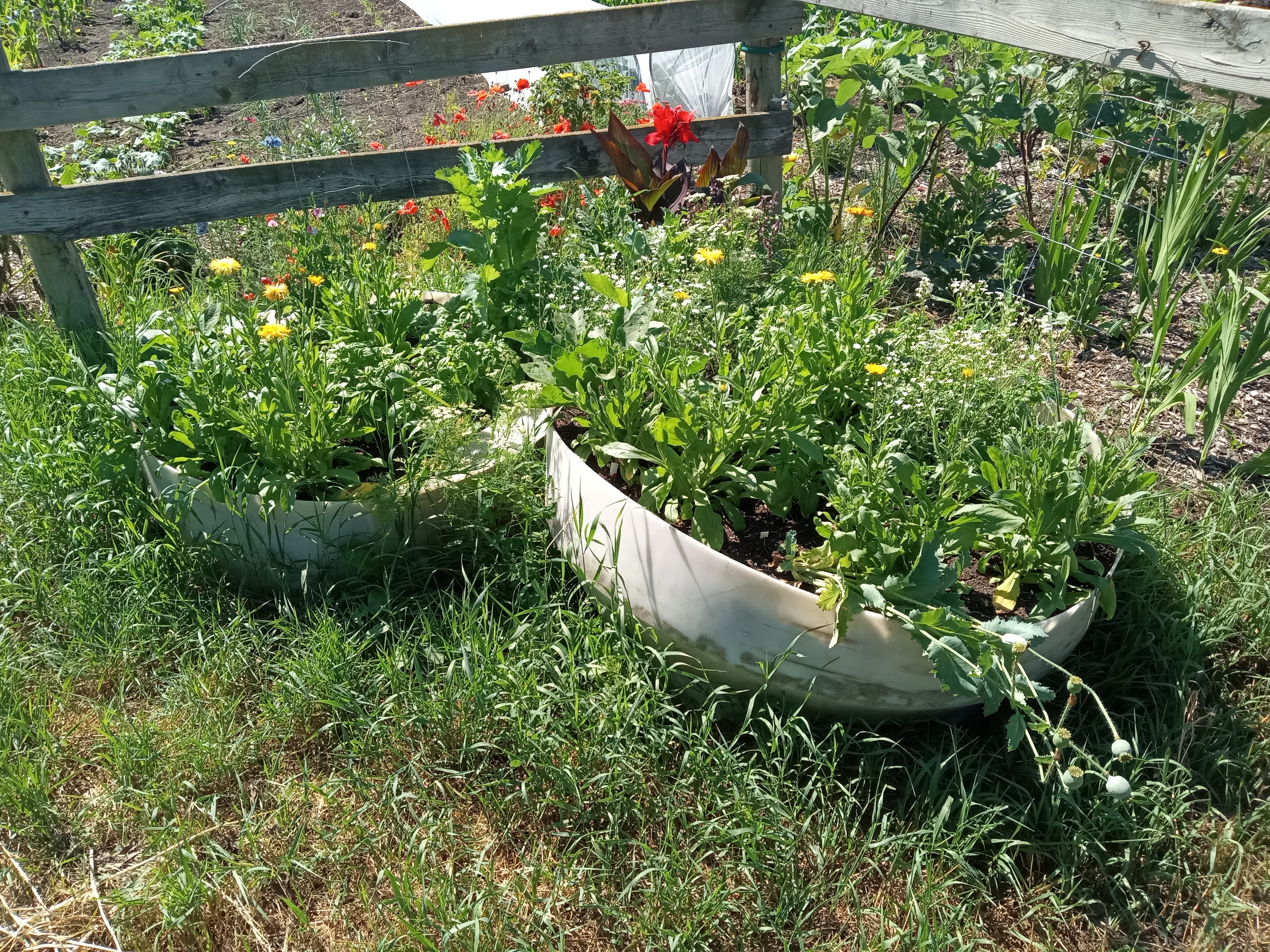
And the container gardens were doing well. It was looking like it could be a good year for the garden.
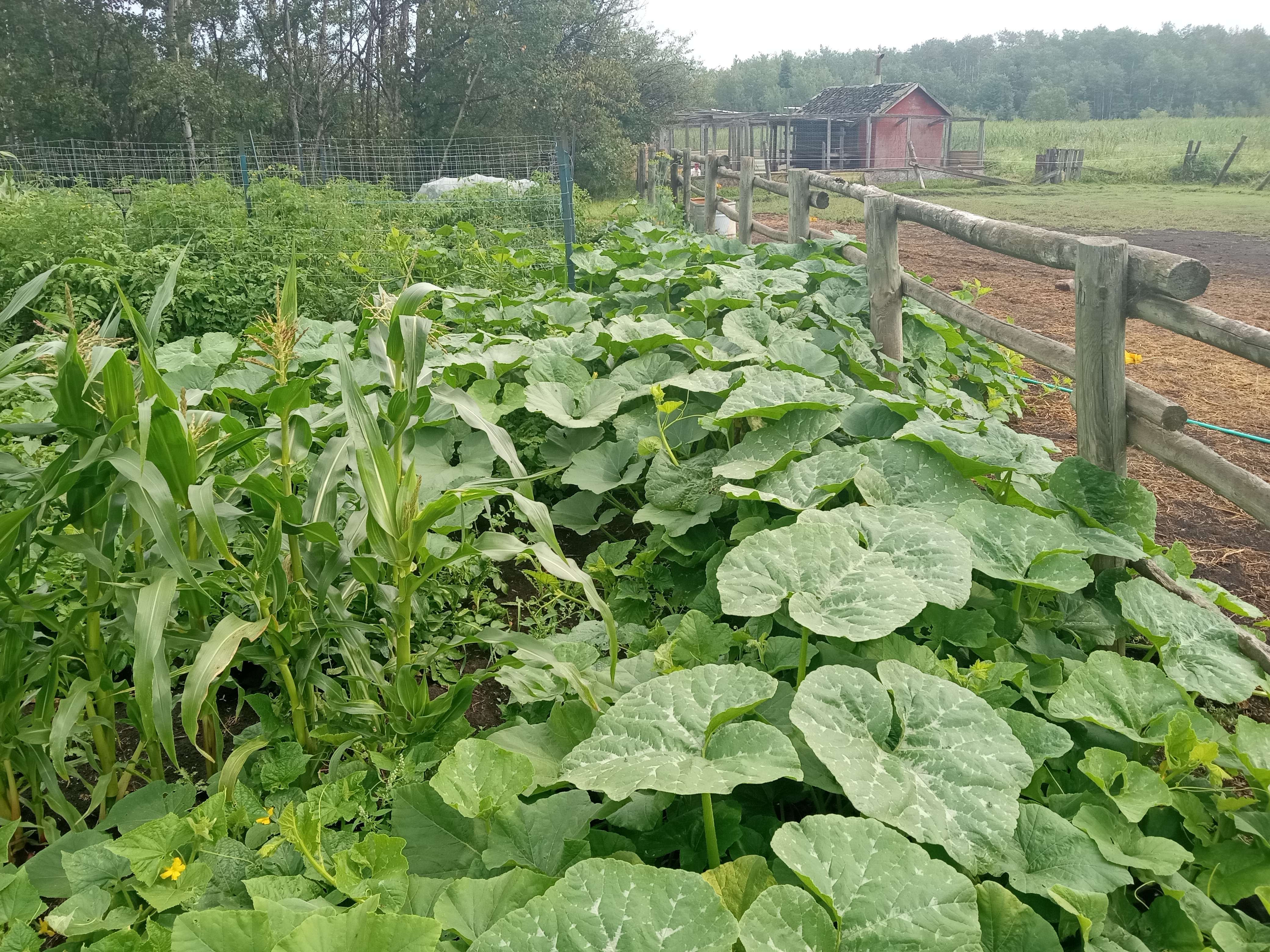
And just a couple weeks later, on August 19,the garden was looking fantastic.
As was the food forest orchard garden, including the apples.
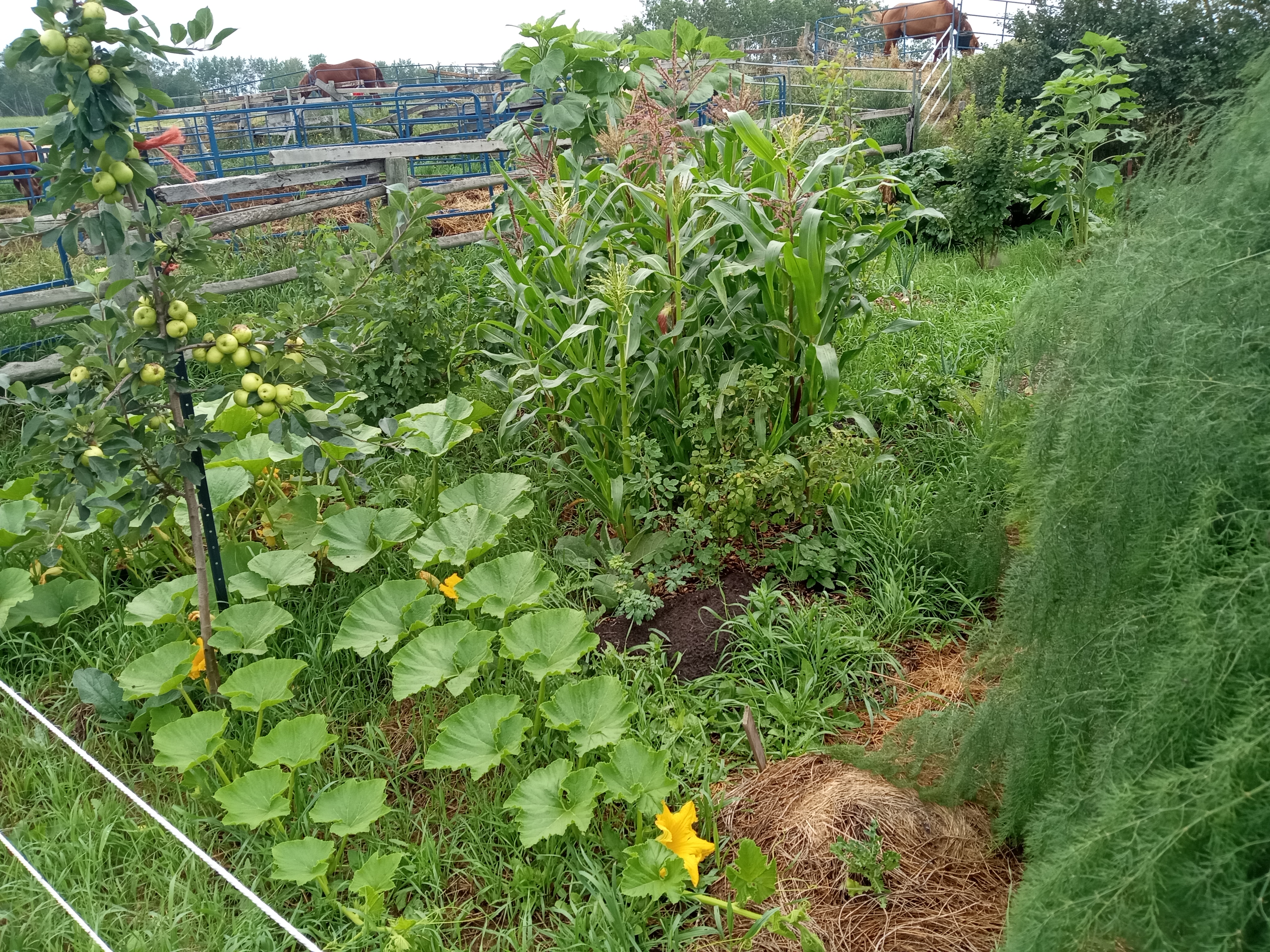
The garden was doing so well that I was able to harvest some annual herbs on August 8, 42 days after transplanting. And by August 15, the first harvest of a couple zucchini was made. By August 25 a couple cucumbers were enjoyed and by August 28, 2 months after planting, a large harvest of various vegetables was completed with an even larger harvest completed on September 5.
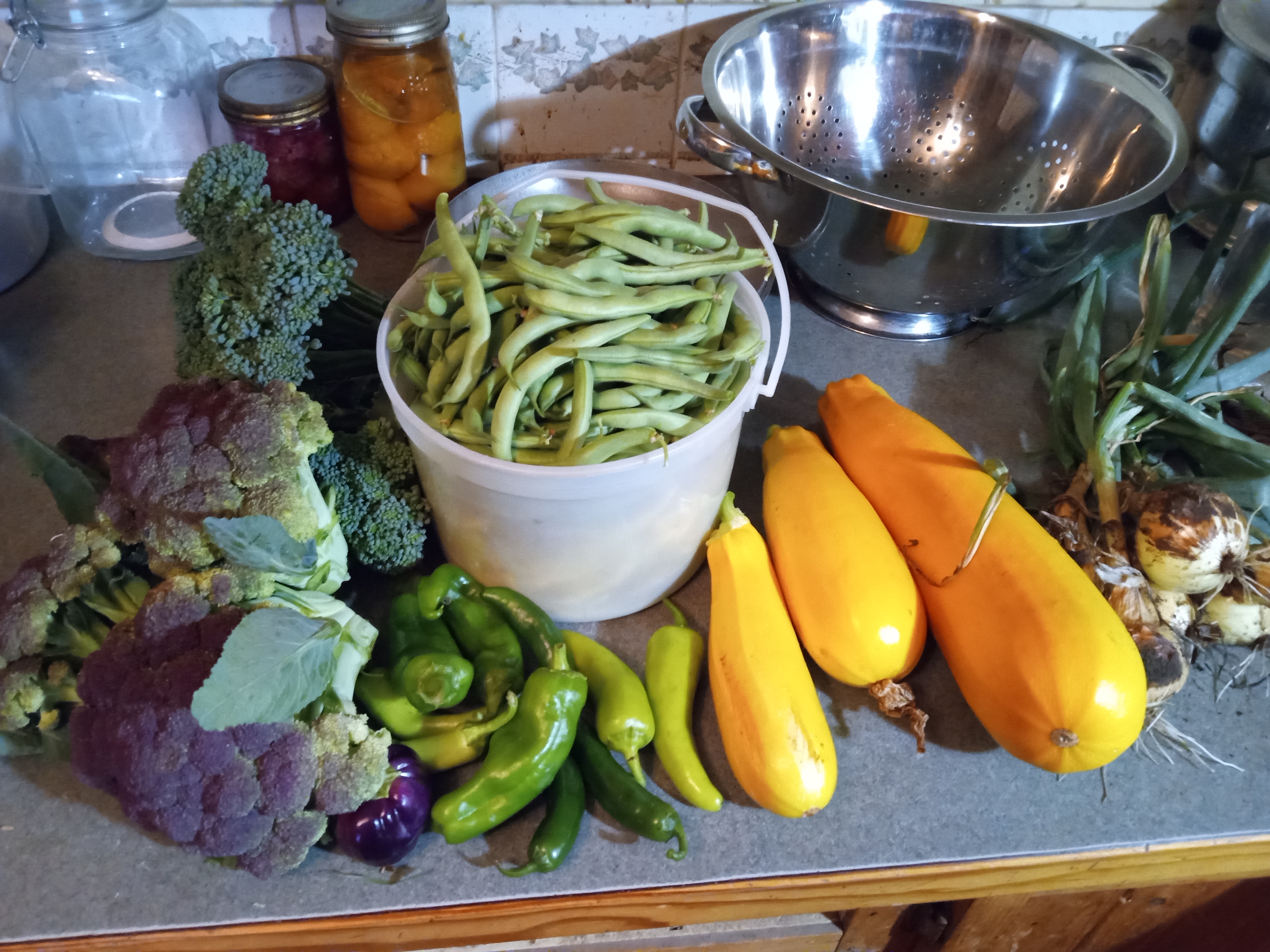
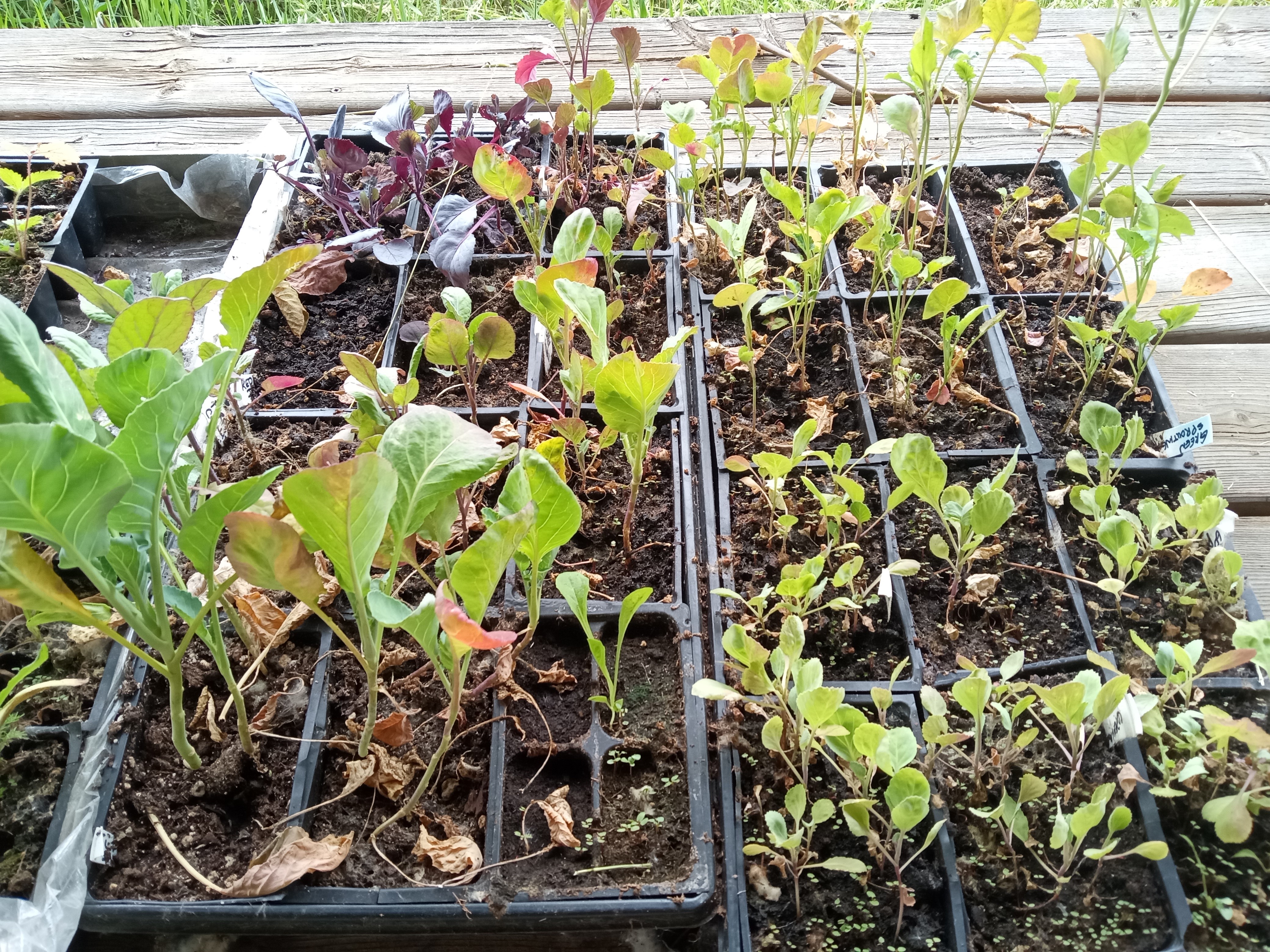
What was surprising about the September 5 harvest was that I was able to harvest brassica's. When I planted the brassica's the seedlings were pretty poor and I did not expect them to do anything. But I decided to try and so glad I did. Who would have thought that these poor leggy plants would amount to anything.
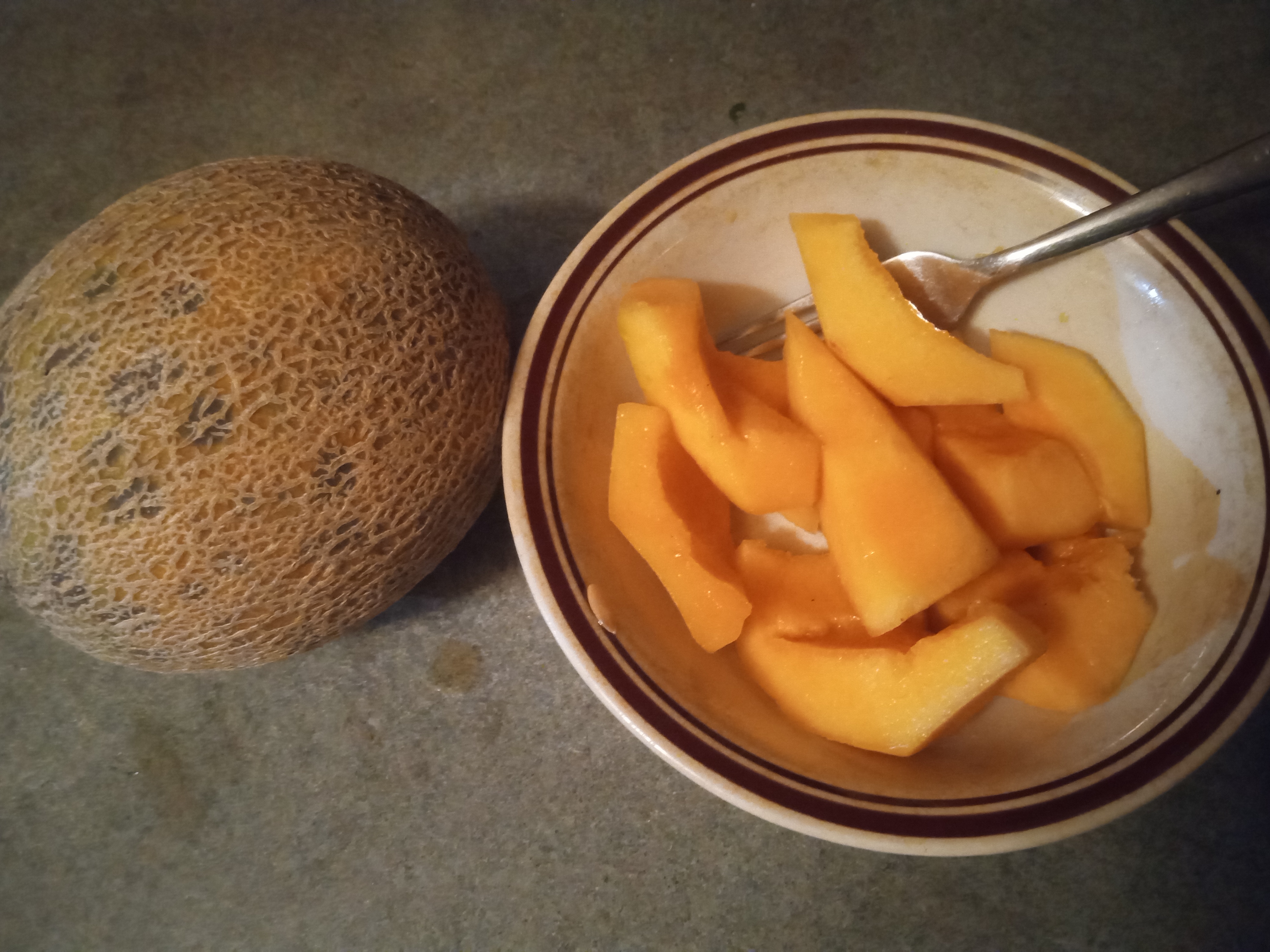
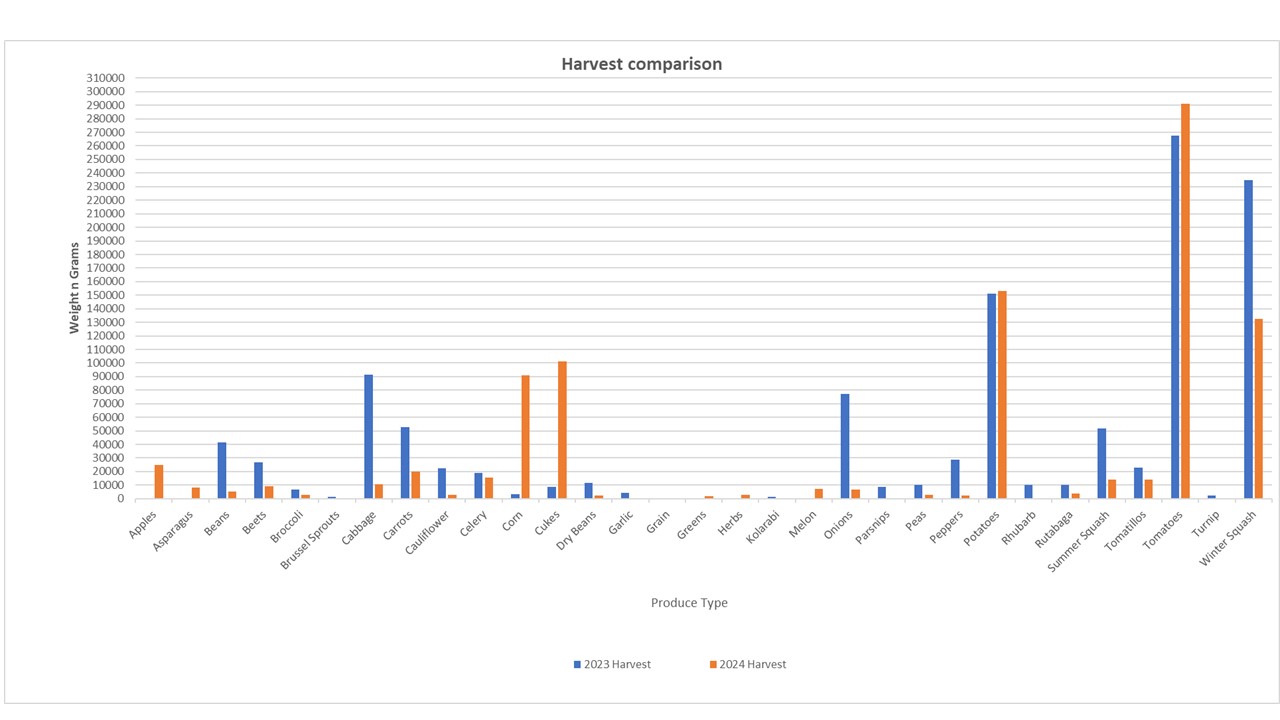
For the remainder of September many harvests were completed as the produce came in with abundance. As an example, over 101 kg (222.7 pounds) of cucumbers were picked from my two 60 foot (18.2 m) rows during the month. I was even able to enjoy a couple feeds of cantaloupe. The best I have ever had!
But like all gardens in this part of the world, the frost is bound to happen eventually. The first killing frost for me in 2024 came on September 26, 90 days following when I planted the main crop garden.
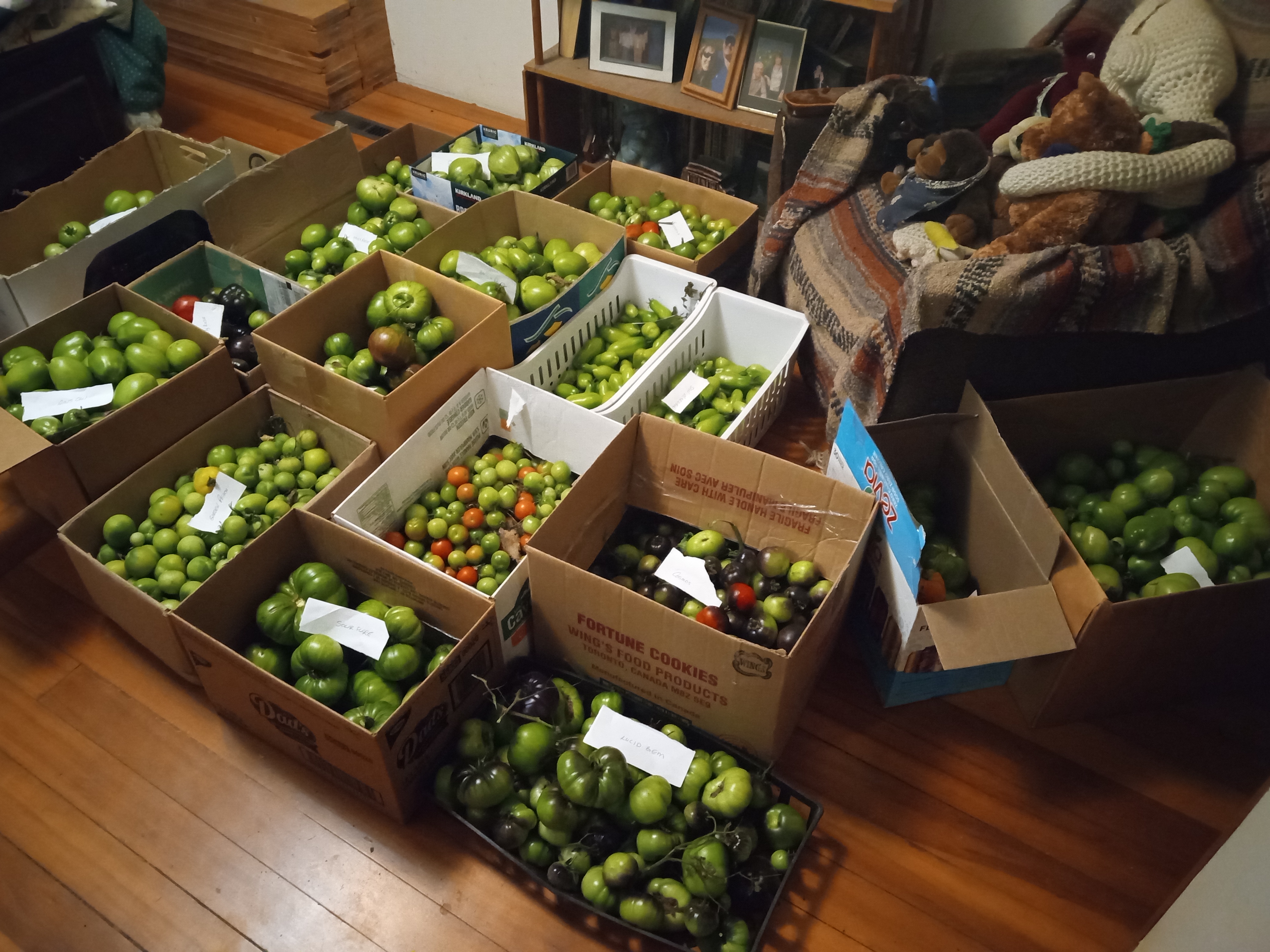
So as not to loose anything to the frost, starting a couple days prior to the forecasted frost I harvested anything and everything that would be harmed. Everything was weighed and recorded for future analysis. There was a lot of food all over the house. All the tomatoes were picked green amounting to a harvest of 291 Kg (641.5 pounds) which were stored in one of four locations to ripen. I am three years into a tomato trial so I grow a lot of tomatoes. If you are interested, check out The Tomato Trial - Results of 2023 Tomato Trial and What's New for 2024.
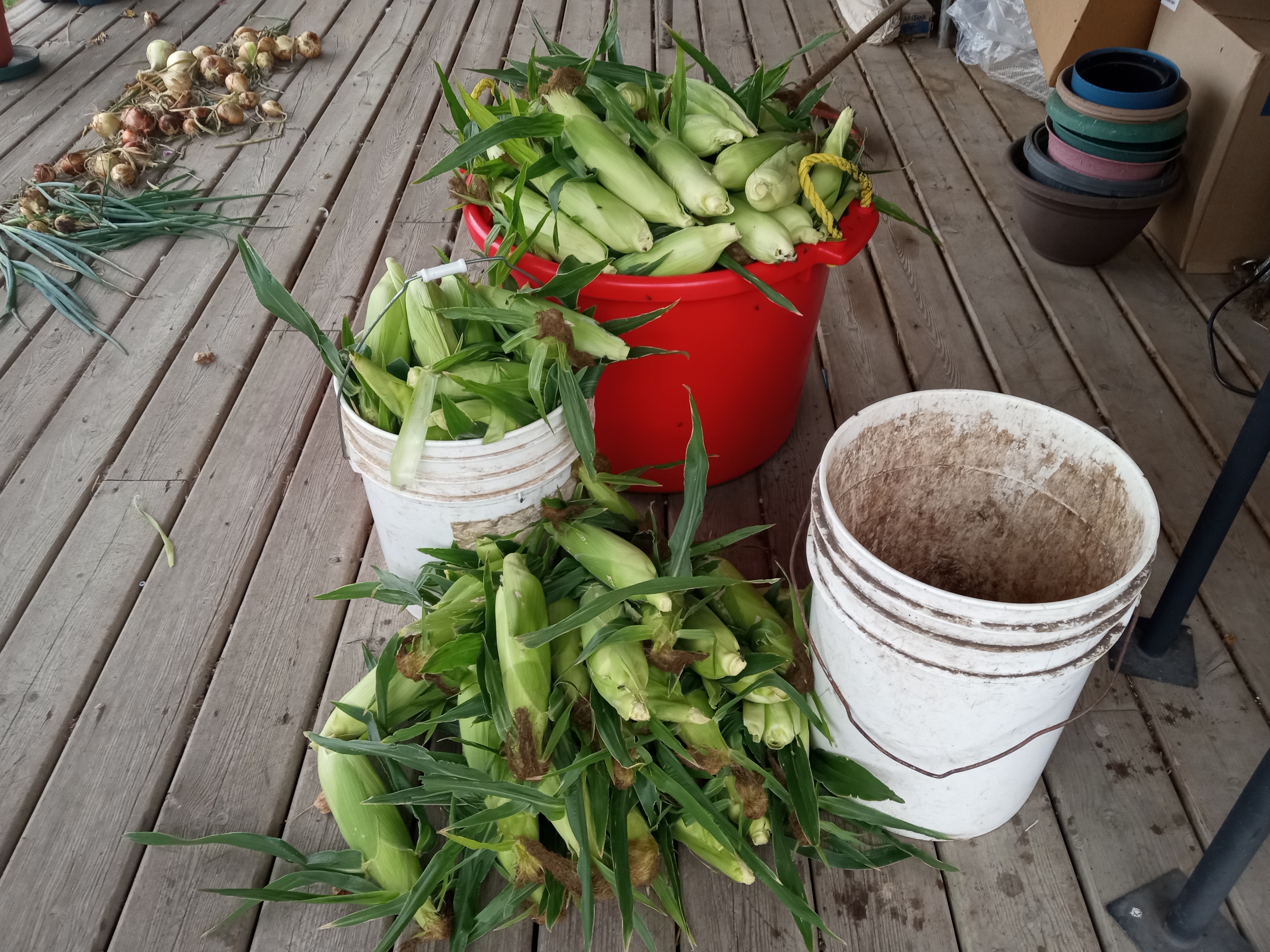
Over 91 Kg (200 pounds) of sweet corn was picked.
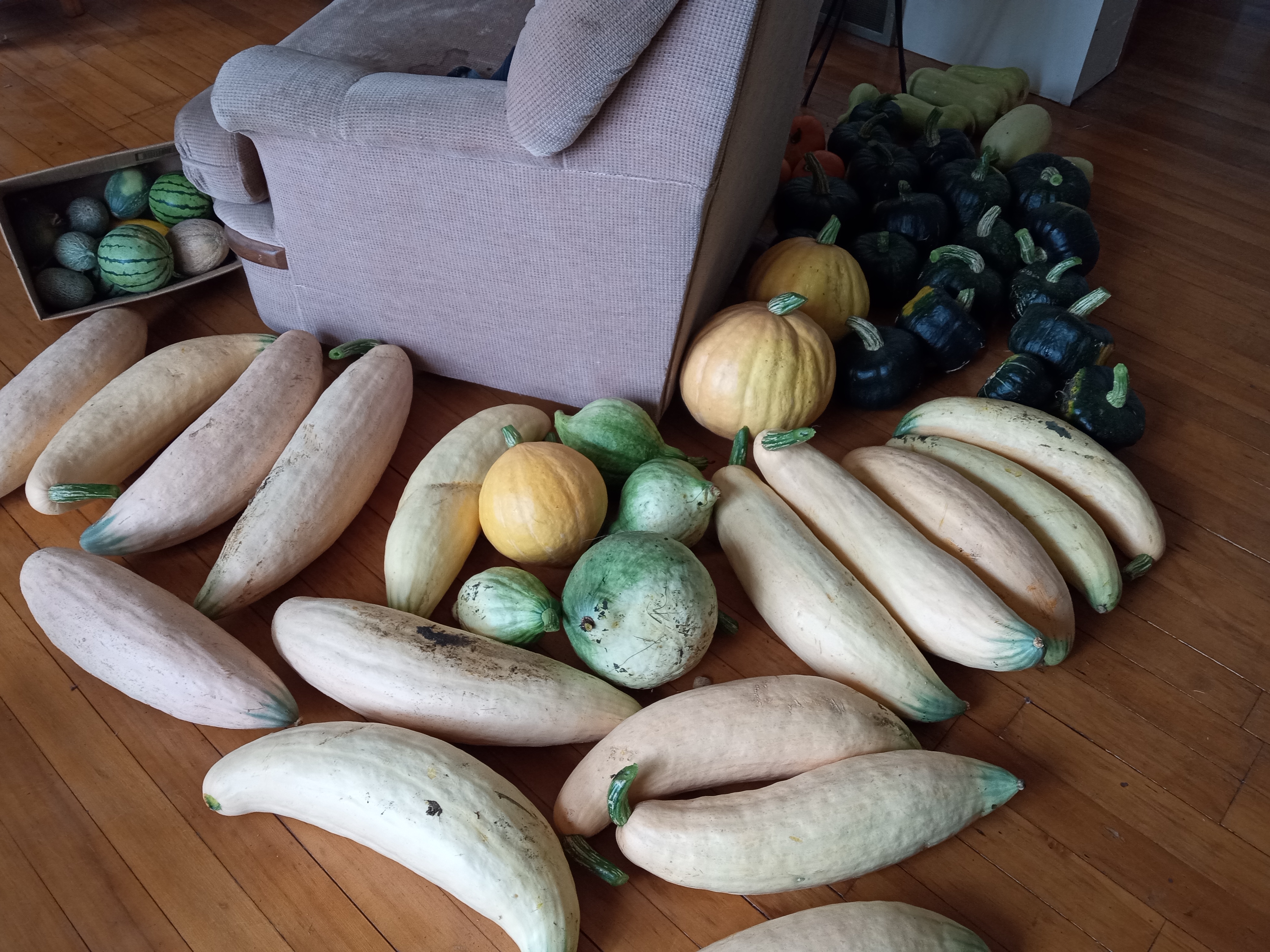
And over 132 Kg (291 pounds) of winter squash was harvested and put in the living room to cure.
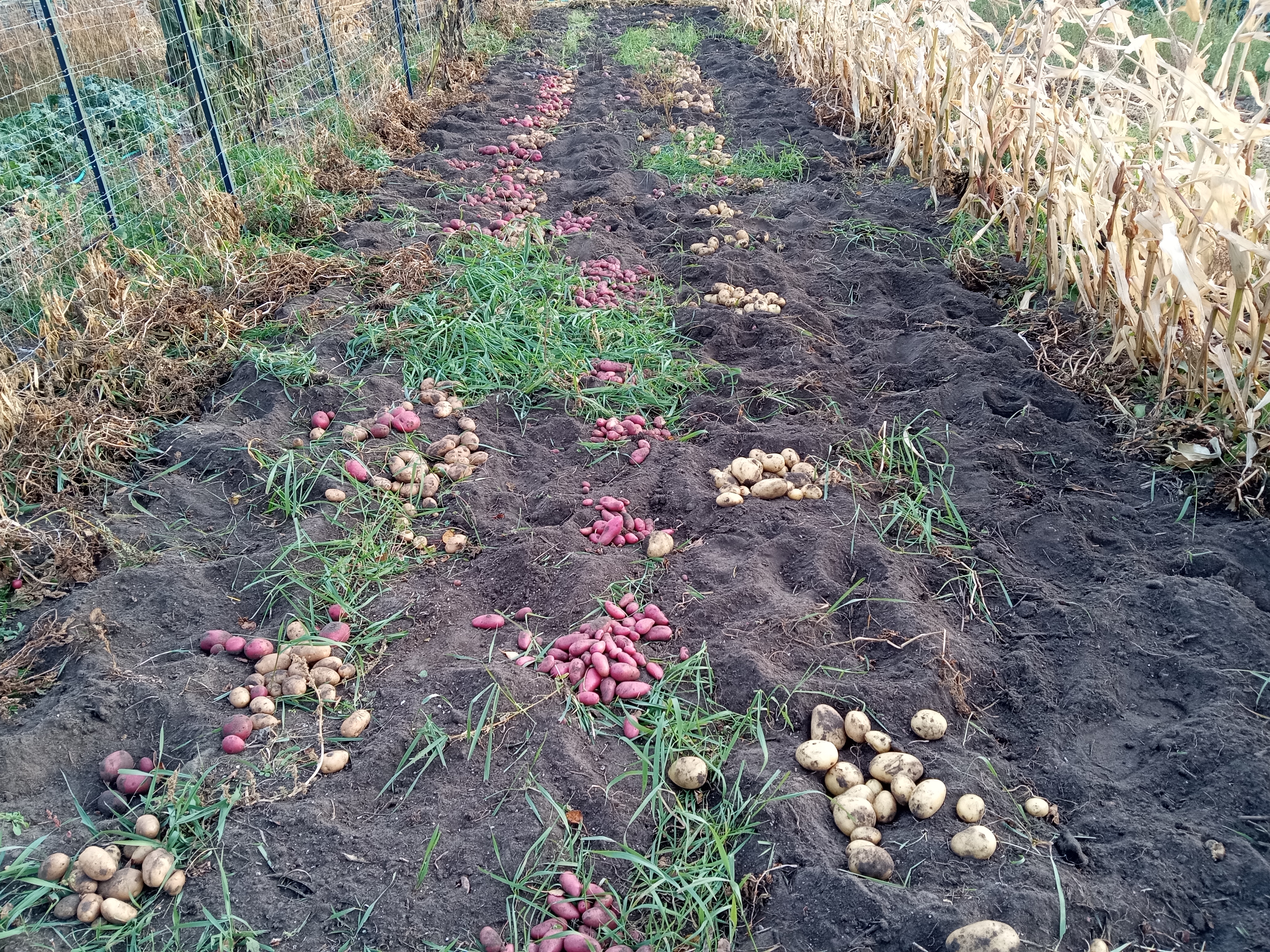
But the garden wasn't done yet. It was another 19 days until I harvested the root crops. Although the root crops are not growing, I like to leave them in as long as possible so that they will cure, sweeten in some cases but mainly so they last longer into winter when stored. So on October 14 I harvested everything that was left. Although the carrots did not do well I still got 22 Kg (48.5 pounds), but the potatoes made up for the shortfall with over 153 Kg (337 pounds) being harvested from about 100 hills. I am in search of a good storing potato for my storage conditions so have been trialing potato varieties. If you are interested, check out The Potato Trial - In Search of a New Potato Variety that Works for Me.
All in all, for a garden that only grew on average for 90 days with in ground storage for another 19 days, I was extremely surprised and happy with the 927.9613 Kg (2,045.8 pounds) or produce I was able to harvest. The total harvest was down a bit from 2023 but with the lost two weeks or so at the beginning and the weather we had, it's not surprising really. But, was it worth it dollar wise?
Garden Analysis
As I did in 2023, to determine if the garden saved me money I would need to know how much everything I harvested weighed. And so, throughout the entire growing season I weighed every vegetable I brought into the house, recording it by vegetable type. Anything eaten fresh in the garden was not weighed. At the end of the season I knew I had done well, all things considered, but I did not know how well until I did the analysis. Surprising to me was that from my main crop garden and food forest orchard garden, I harvested 927.961 KG (2,045.8 pounds), down slightly from my 2023 harvest of 1,172.2 Kg (2,584.3 pounds). When I plant my garden, I base it on how much I have left in the cellar and so each year the volume of one produce category can be more or less than the year before. This gardening style coupled with the later than normal planting, poor germination and growth of some things, would account for some of this decrease in harvest.
Produce Comparative Analysis
As I did last year, I went on line to a grocery store that claims you can save on food, and got the regular prices of each type of produce in Canadian dollars per 100 gram. But this year I decided to get the organic food prices as well. After all, if you are not growing a garden you will be in one of three camps - the cheaper the better or only organic or organic when available. I chose to compare against the cheapest comparable produce for one comparison and then do my Organic comparisons using organic when available and regular pricing when not. In reality my garden would fall under the organic category but the hope was that using the cheaper prices would show that gardening can still save money.
To determine my cost of production, I got a little more elaborate this year and recorded the time spent planning, seeding, watering and harvesting. Or at least I tried to be consistent with recording it, but I also know that sometimes I forgot. And so, I added an extra 24 hours onto the labor time before applying the 20.00 per hour to total. Also included in this cost was the cost of seeds and roots I bought (potatoes and asparagus). I used the same dollar value as last year for this cost as this seemed reasonable. With all the costs factored in, my total cost of producing 927.961 KG (2,045.8 pounds) of garden produce is $5,037.00 CDN ($3,550.75 USD).
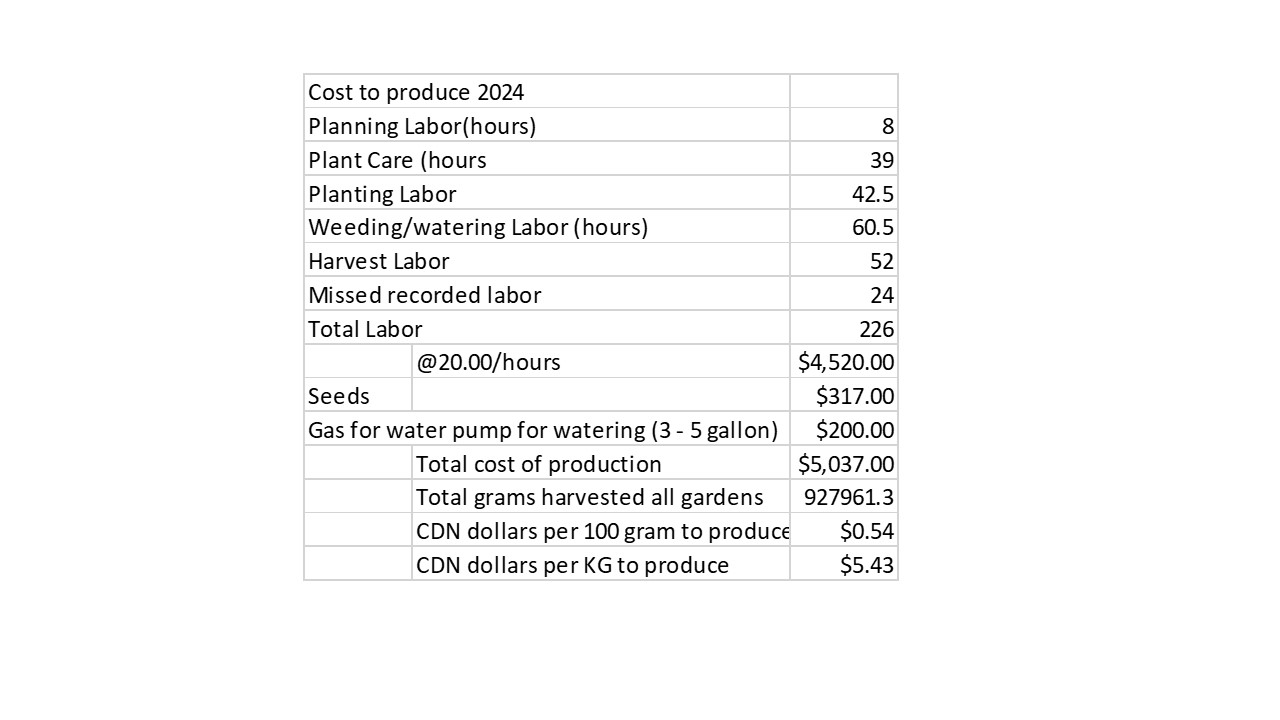
With the cost of production determined, I was then able to determine that every 100 grams of food grown, regardless of type cost me $0.54 CDN, up from the $0.36 CDN in 2023. With this cost of production, I was then able to determine the cost to grow each produce category.
The final comparison was buying from the Farmers Market. As prices vary, I calculated the costs at $3.00 CDN ($2.11 USD) and at $4.00 CDN ($2.85 USD) per pound.
Now that I have set the stage for this analysis, let me share the findings...
Does Gardening Save Me Money
As in 2023, the 2024 comparative analysis showed me that although for some things I would have been further ahead to buy in the store, overall, the cumulative saving was worth the efforts. Specifically, the analysis showed that:
- My total cost to produce 927.961 KG (2,045.8 pounds) was $5,037.00 CDN ($3,550.75 USD);
- To purchase a conventionally grown version of comparable produce in the store would have cost me $6,919.13 CDN ($4.859.43 USD);
- To purchase organic when available and when not available, a cheaper version of comparable produce in the store, it would cost me $8,645.52 CDN ($6,071.91 USD);
- To purchase this same produce at the farmer's market at $3.00/pound would have cost $6,137.41 CDN ($4,310.42 USD). Interestingly, this is cheaper than buying in the store;
- To purchase this same produce at the farmer's market at $4.00/pound would have cost me $8,183.22 CDN ($5,747.23 USD).
As I outlined in Establishing a Food Forest Orchard Garden - But Will it Save Me Money the overall savings in 2023 for all the gardens was $489.74CDN ($368.47 USD) from 1,172.196 kg (2,584.3 pounds) of produce grown. Compared to the realized 2024 savings from a reduced harvest of 244.2352 Kg (538.5 pounds), I realized a savings of $1,882.13 CDN ($1,326.78 USD) over buying conventional produce, an increased savings over 2023 of $1,392.39 CDN ($981.54 USD). Comparing my produce to in store organic produce, when possible, a savings of $3,608.52 CDN ($2,543.76 USD) was realized and a savings of $1,100.41 CDN ($775.72 USD) was realized over buying at $3.00 per pound at the farmers market.
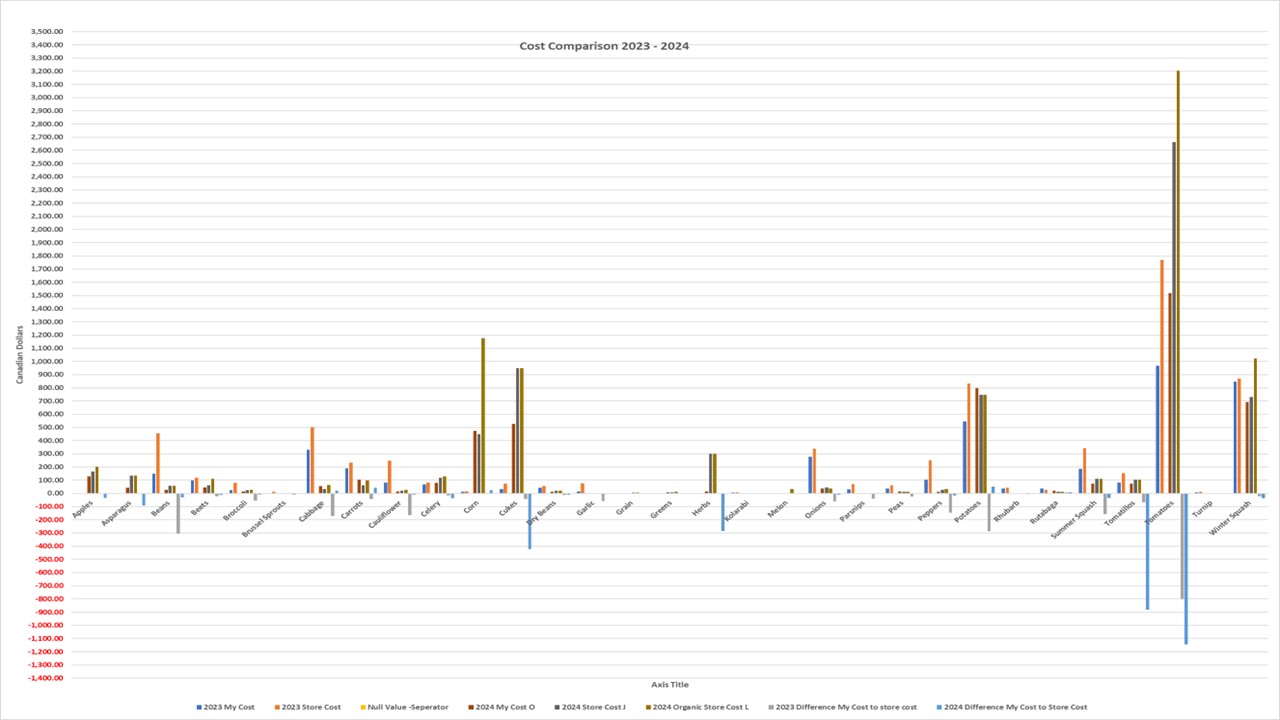
Although I am happy to be able to say that once again the garden has saved me money, I questioned why I realized such a large savings over 2023 despite a lower harvest. As this graph illustrates, although some conventional foods are worth less in the store, the quantity and what I grew of some produce affected the bottom line. I suppose one could glean from this that I should only be growing certain food types to capitalize on the savings but I think it is safe to say that despite growing everything and averaging the results to achieve a $1,882.13 CDN ($1,326.78 USD) savings is absolutely perfect. But as I stated earlier, my garden would be considered organic so to realize a $3,608.52 CDN ($2,543.76 USD) savings, is certainly worth the effort. None the less, I find the graph interesting.
Final Thoughts
When one undertakes any type of data collection and analysis, I have to be prepared for the results that it will show. Happily I am able to confirm my assumptions that gardening does in fact save me money. It may be a hobby to some and it may not be worth the effort to others but for me, putting me into contact with the earth, knowing where my food comes from, having fresh produce coupled with saving me money in the grocery store is a huge win, I'd say.
But the analysis also showed me some interesting things such as:
- I planted 10 more tomato plants than last year (172 in total) and I harvested 23.4 Kg (51.6 pounds) more this year and realized an increased savings of $342.31 CDN ($240.41 USD);
- I planted 40 more hills of potatoes in 2024 but only gained 1.660 kg (3.7 pounds) more than last year. The squash patch overtook part of the potatoes;
- I harvested 8.975 kg (19.8 pounds) less Tomatillos than 2023, but realized an increase in savings of $811.36 CDN ($569.83 USD);
- It was a good year for cukes, saving me $423.22 CDN ($297.24 USD).
All in all, I am pretty happy with the savings I realized over buying a cheaper comparable product in the store. By growing my own produce in the main crop and food forest orchard garden I saved $1,882.13 CDN ($1,326.78 USD), a 284.3% increase over 2023 even with the increase to cost of production to $0.54/100 grams from the $0.36/100 grams in 2023. By not having to buy organic in the store supplemented with cheaper comparable non organic produce, I saved $3,608.52 CDN ($2,543.76 USD). And by not going to Farmer's Markets I saved $1,100.41 CDN ($775.72 USD) at $3.00/pound produce and $3,146.22 CDN ($2,217.87 USD) at $4.00/pound produce.
So can I get food cheaper in the store? Maybe for some things, but overall as this year has proven again, it is still cheaper to grow it yourself. And with knowing what was put into your garden, the fresh air and the exercise, you just can't beat this for healthy living.
I hope you found this of interest, that it gives you some food for thought and that it helps to encourage you to grow your own food, however big or small. Even one container garden on the deck can give a lot of fresh, nutritious, delicious food that will also save you money. If you did enjoy it, please consider joining the My Boreal Homestead Life community. By supplying your email address at the bottom of the page and hitting "sign up" or by clicking Join the community, you will ensure you get an email notification when I post new blogs to the My Boreal Homestead Life site.
Thank you for joining me on the front porch of My Boreal Homestead Life as we explore this Homegrown, Homestead life, In a Modern World.
Additional Resources:
- Sask. gardener does the math on homegrown produce - Interview I did on CBC Radio
- Every garden should have this perennial vegetable
- Growing Garlic In Raised Bed Garden For Culinary and Medicinal Use
- Fall planting of cool weather crops for fall gardening in Zone 3b
- How to container garden
- Does Gardening Save Money - Melissa K Norris
- Can a Vegetable Garden Save You Money? - Iowa State University
- Get Healthy and Save Money by Food Gardening - National Gardening Association