I have always viewed quack grass as something to feed livestock with and although they enjoy it, rhizome's included, it was not something that is commonly given unless it was in the bales or pastures. In the yard, it was only ever something to make the yard green. Other than that, it was something that I called the bane of my existence. It's propensity to thrive in all growing conditions is the very thing that makes it one of the harder “weeds” to get rid of in places that I don't want it. But maybe, just maybe, I have been looking at quack grass all wrong.
The Quack Grass Plant
Elymus repens, also known as Agropyron repens or Elytrigia repens, but better known by the common names of Quack Grass or Couch grass, is something that most folks know a lot about. But not in a good way.
According to a 1962 bulletin published by the West Virginia University, Life History Studies As Related To Weed Control In The Northeast, quackgrass was introduced from Europe around 1751 most likely by mixed grass seed. From that time it has rapidly spread across most of the Northern United States and Canada with it's ability to thrive in the cool weather. With it's ability to propagate by seed and through rhizomes, coupled with it's allelopathic properties, it very quickly became known as an invasive weed. What a resourceful plant!
And in Canada, the Ontario government in a report titled Quackgrass reports that “the first written account of quackgrass in Canada was in 1861, although it is likely that the weed had been present since Europeans first sowed cereal crops in Canada. By 1923 quackgrass was considered one of the three worst weeds in Eastern Canada. Today, it can be found in all of the provinces as well as the Northwest Territories. A recent survey estimated that 17.8 million hectares (44 million acres) or 56% of Canadian farmland has quackgrass present.”
Originally thought to be a variety of wheat, it was called Triticurn repens and Agropyron repens was even crossed with wheat in the early 1930's according to the West Virginia University article. But the success of this project was short lived, due in part to the invasive nature of the quack grass genetics. And it is this propensity to thrive that has resulted in more attention to it's control rather than anything else.
With it's ability to spread vegetatively via rhizomes that can travel many feet from the parent plant with an uncanny ability to go around and through things that are in it's way, it does not take much for one plant to quickly spread. Couple this with its ability to have even the smallest piece of a rhizome start a new plant, a clone of the parent, it becomes a force to be reckoned with. Quackgrass wants to survive and so in addition it's vegetative propagation, it will also produces seed. According to the Ontario government report titled Quackgrass, “It is considered to be self-sterile and relies primarily on wind for cross-pollination. Flowering occurs in late June to July and the seeds mature in early August to September. Commonly, 25 to 40 seeds per stem are produced in green to bluish-green spikes which are 5 to 30 cm in length. Seeds drop in late September where they overwinter in the leaf litter or on the ground. The seeds can remain viable for 1 to 6 years. Viability can be maintained even after passing through the digestive tract of most farm animals, except swine.”. But it is this open cross pollination that “adds to the difficulties in controlling this pest.” according to the West Virginia University report Life History Studies As Related To Weed Control In The Northeast.
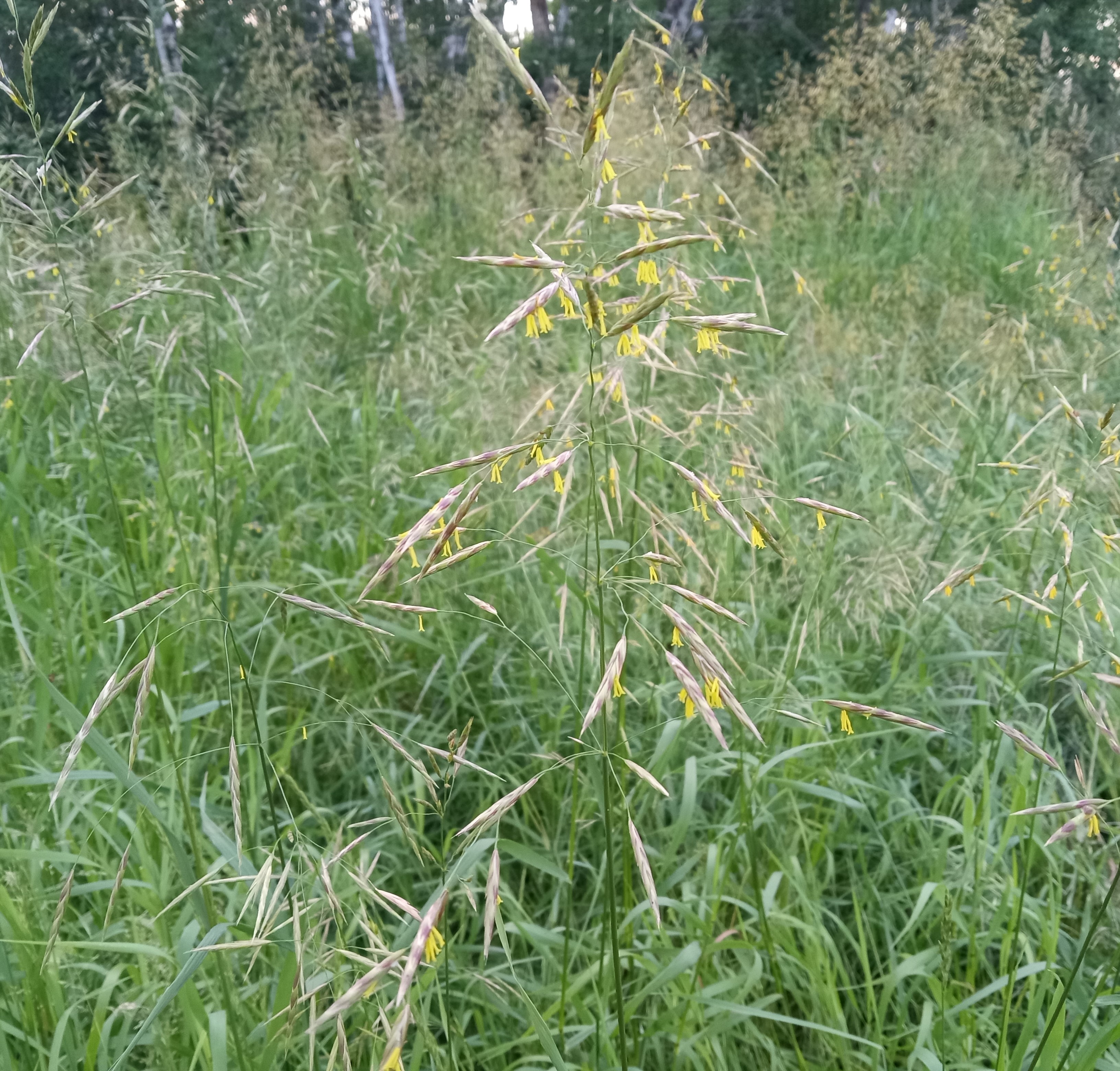
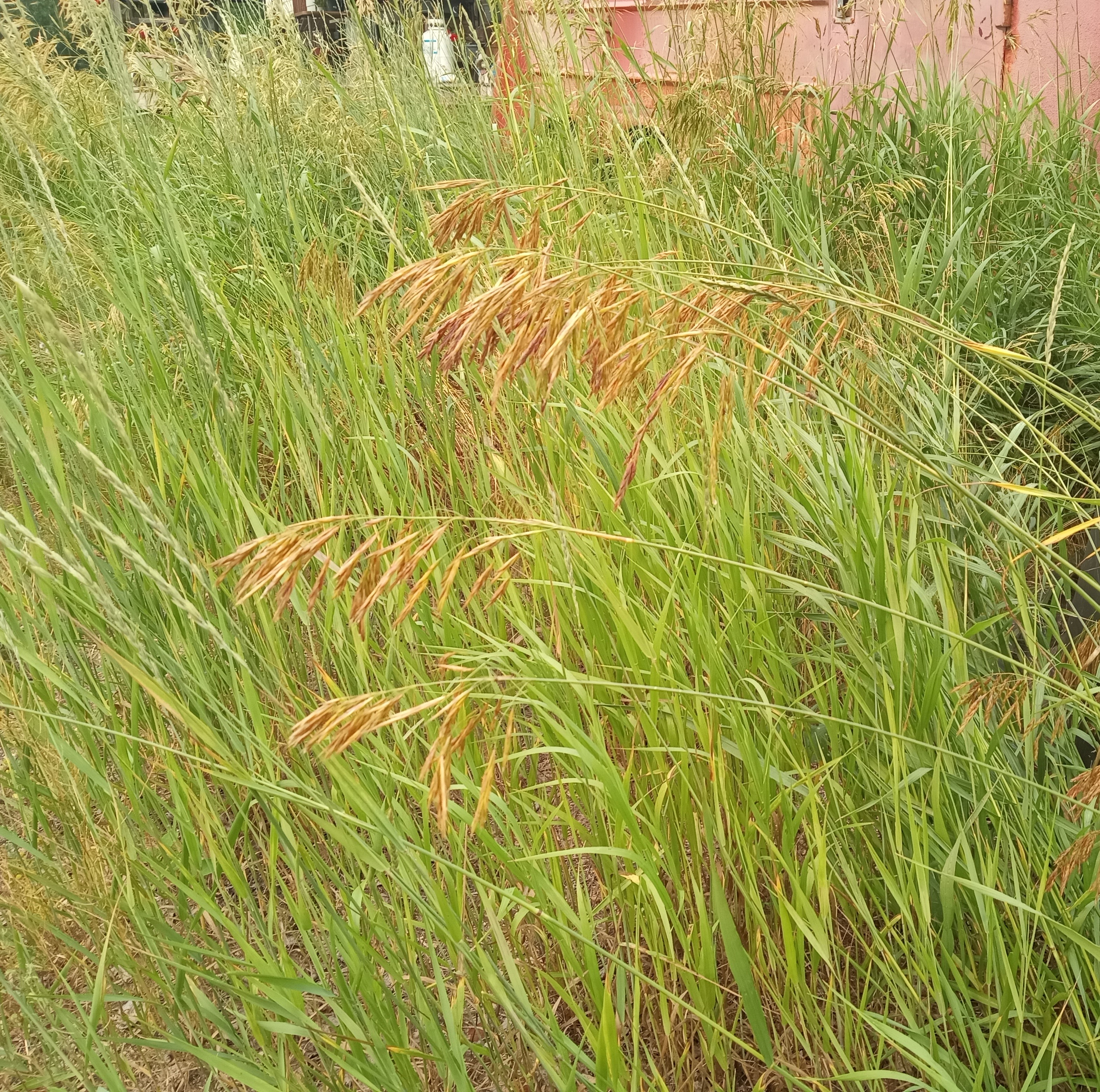
The seed head is born from plants that have leaves that are typically 9 to 10 mm wide, 6 to 20 cm long and finely pointed.
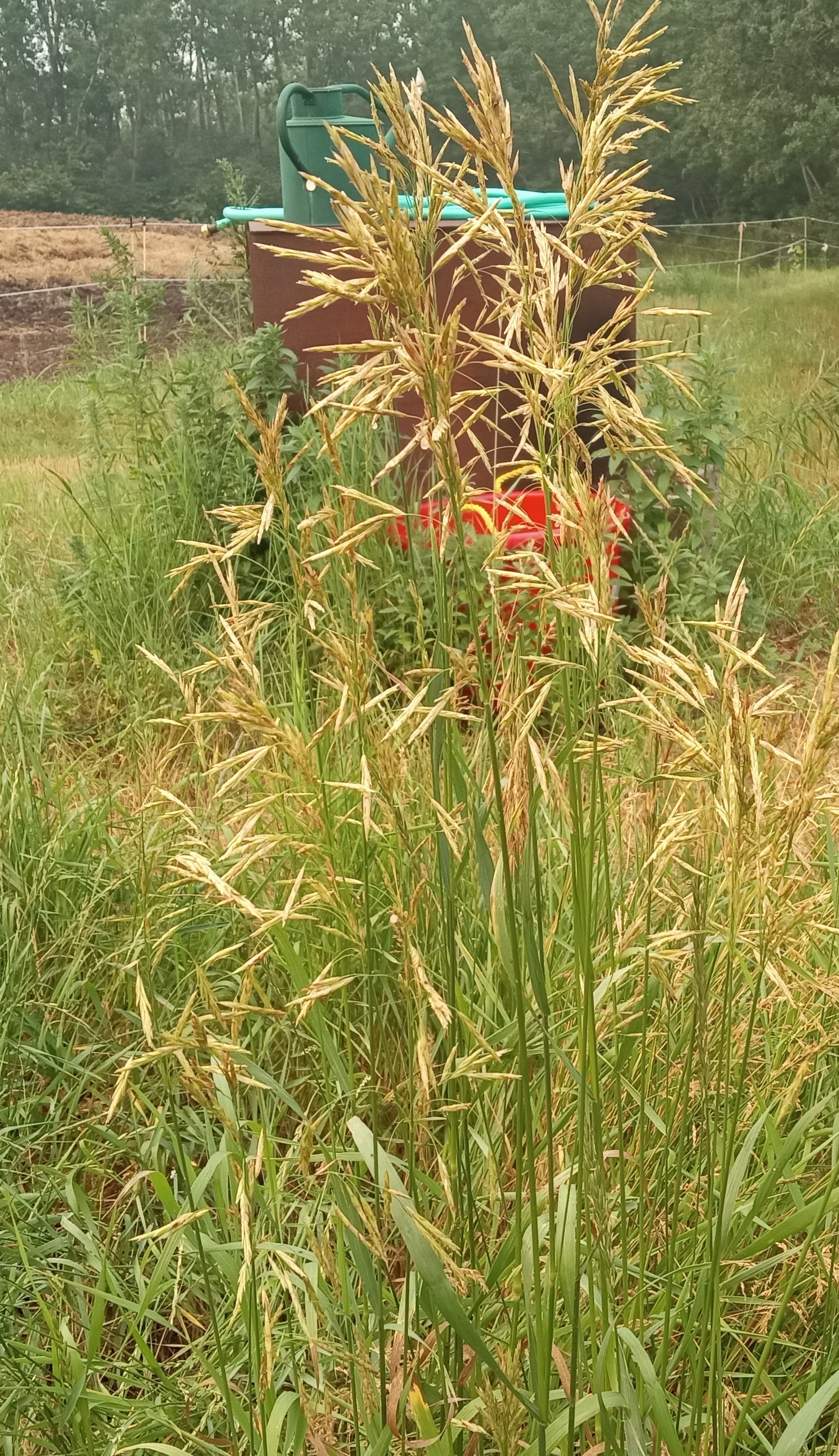
The Ontario government report titled Quackgrass further describes the plants as “flat, pale yellow to green in colour with a very fine growth of hairs on the upper surface and a smooth lower surface. The leaf sheaths are round, split, and have overlapping margins. Ligules are short (0.5 to 1 mm), obtuse and membranous. Auricles, fine projections at the leaf-node junction, clasp the stem. Stems are hollow, round and slender with 3 to 5 nodes; stem length varies from 30 to 120 cm.”. Because of the cross pollination, sometimes the appearance of the plant may vary from that which the Ontario government describes.
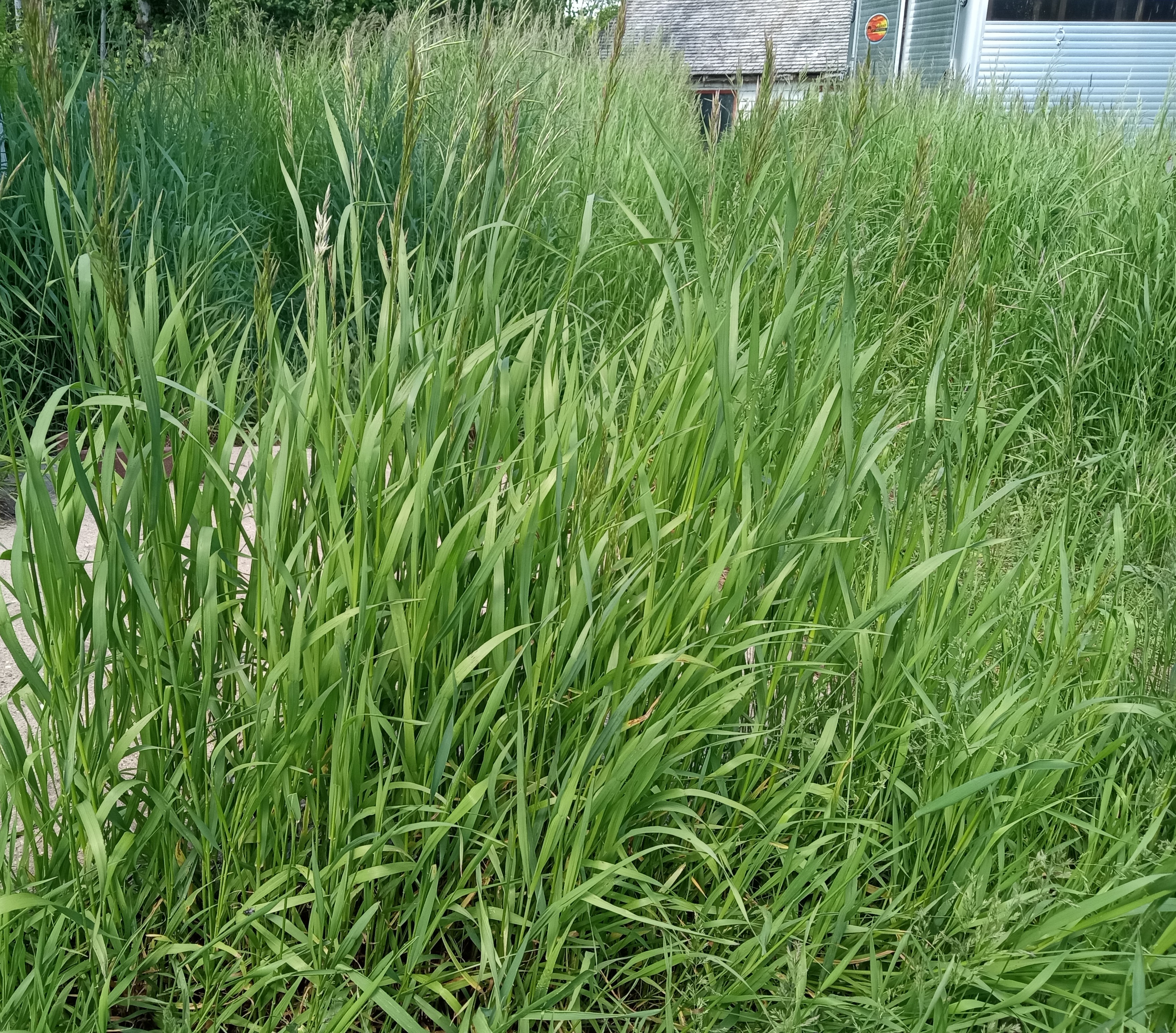
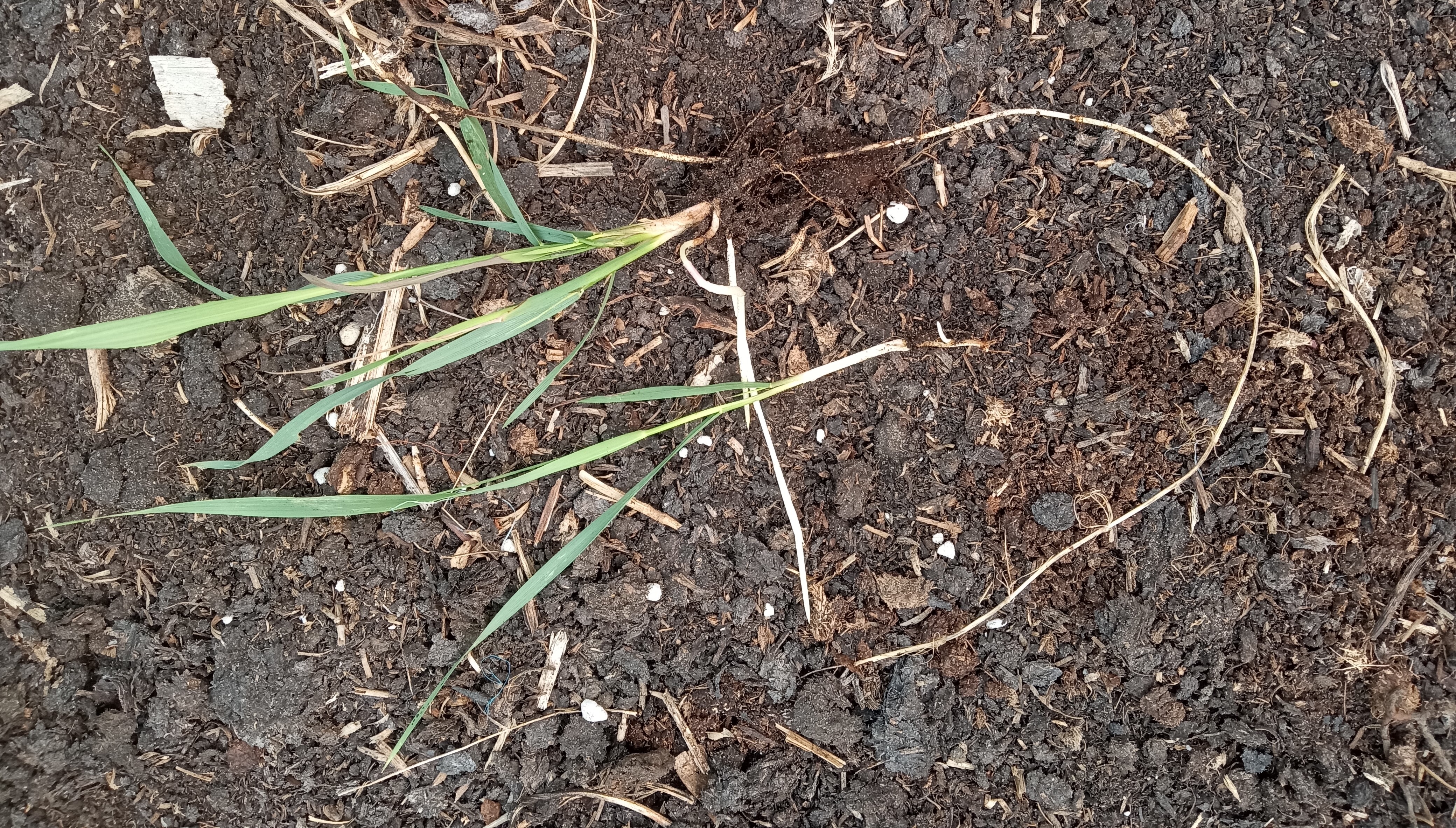
But the white 1.5 to 5 mm wide rhizomes with it's nodes and roots coming out at the nodes and the pointy rhizome tip are a dead give away to it's identification.
With the ability of quack grass to thrive in all sorts of soil conditions, it is not a surprise that the the Ontario government report Quackgrass estimates that “quackgrass can absorb approximately 55%, 45%, and 68% of the total nitrogen, phosphorus and potassium, respectively, available for plant use.” which can affect commercial crops and “effectively reduce crop yields by as much as 25% to 85% in corn, 19% to 55% in soybeans, and up to 57% in wheat.”. The Manitoba Agricultural Department estimates that “When present in dense patches (more than 900 shoots per square metre or sq. yd.), quackgrass can reduce wheat yields by up to 100%. For example, 500 shoots per square metre (sq. yd.) cause about a 50% loss in yield.”. And from first hand knowledge in the home garden, a definite decrease in production can be seen in severe infestations of quackgrass.
I think it is safe to say that quackgrass is definitely a force to be reckoned with. Although I have long admired and cursed the perseverance of quackgrass, imagine my surprise when I learned that there was more to this weed than one would think.
Quackgrass benefits
Admittedly quackgrass does have a lot of things going against it but when one looks past that, I think it can serve some great purposes.
- With it's vigorous growth habits and dense rhizome networks, it works well for stabilizing slopes against erosion;
- It is good forage. Research shows that quackgrass is similar in protein to timothy grass and the report Quack Grass (Agropyron repens L.): As Ruminant Feed reports that “Crude protein for QCK was 8.9%, a value lower than 14.5% reported by Stoszek et al. (1979) for immature QCK and of 17.2% reported by Marten et al. (1987) for common QCK harvested at joint.”. But equally as interesting is that the 1962 report published by the West Virginia University titled Life Studies as Related to Weed Control in the Northeast showed that “Plots receiving no nitrogen, phosphate, or potash yielded 4.17 tons in 1958, 1.99 tons in 1959, 1.40 tons in 1960, and 2.87 tons in 1961. Nitrogen additions to quackgrass sods produced significantly higher yields each year.”. That's a pretty good yield when compared to the yields reported in the Canadian Cattleman magazine article titled Feed Watch: August 19, 2019 which stated that “In east-central Saskatchewan, dryland yields are 0.9 tons/acre for alfalfa, 0.9 tons/acre for brome/alfalfa, 0.7 tons/acre for other tame hay, 0.6 tons/acre for wild hay and 1.6 tons/acre for greenfeed.”. Granted, some management would be required as with other hay lands, but if an area is infested with quackgrass, I would suggest that leaving the quackgrass alone might be a good idea rather than attempting to eradicate it. And as an added bonus, the animals love it and according to the table in the Small Farmer's Journal article it is quite comparable to other forages in it's chemical composition;
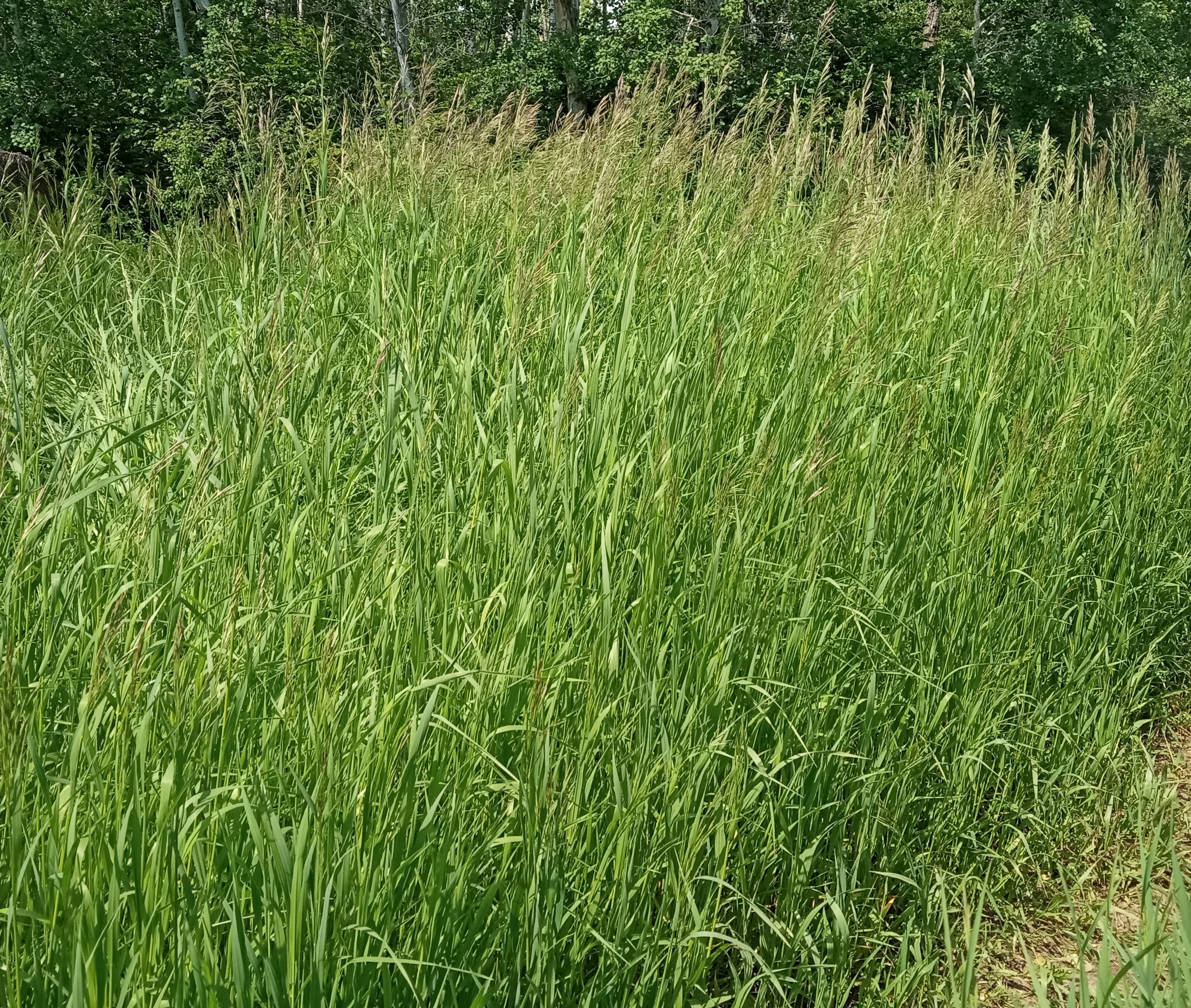
- It can be a food source for humans. Historical studies have shown that the rhizomes can be dried and used as a flour substitute and that the seeds, although minimal in number, can be dried and used as a grain that can be cooked and/or ground to a rye like flour. According to the Small Farmer's Journal article titled Quack Grass, “Both the seeds and rootstocks of quackgrass have been used in times of emergency for food. The seeds yield a fair quality of flour, similar in appearance to rye flour. When gathered in the spring or fall the rootstocks can be ground into flour, which produces a rather heavy, light-colored bread. During the World War this material was used quite freely in southern Bavaria, where it was declared superior to most wheat substitutes. Neither the seed flour nor the rootstock flour is of the highest quality, and its preparation is somewhat laborious, but it is nutritious and not unpalatable.”. Something that is good to know should I need it;
- Medicinal use. I was surprised, but pleased, to learn from reading in Dr. Patrick Jones book The HomeGrown Herbalist Guide to Medicinal Weeds that quackgrass “is an excellent diuretic and has antibiotic and soothing demulcent properties. This combination of actions makes for a nice remedy for gout, bladder infections, kidney stones, urethritis prostatitis and benign prostatic enlargement. It also moves bile and is useful for gallstones, jaundice and liver issues as well. Its antibiotic properties can even be helpful for some respiratory infections. ” . But cautions that “It's a good diuretic. Long term use or combining with other diuretics could lead to some potassium depletion.”.
- According to the Ontario government article, Quackgrass, “Certain natural chemicals extracted from quackgrass have been found to have insecticidal properties against mosquito larvae and molluscs, particularly slugs.”. A fact which has been confirmed by the University of Minnesota in their article titled Quack Grass. Interesting!
Quackgrass control
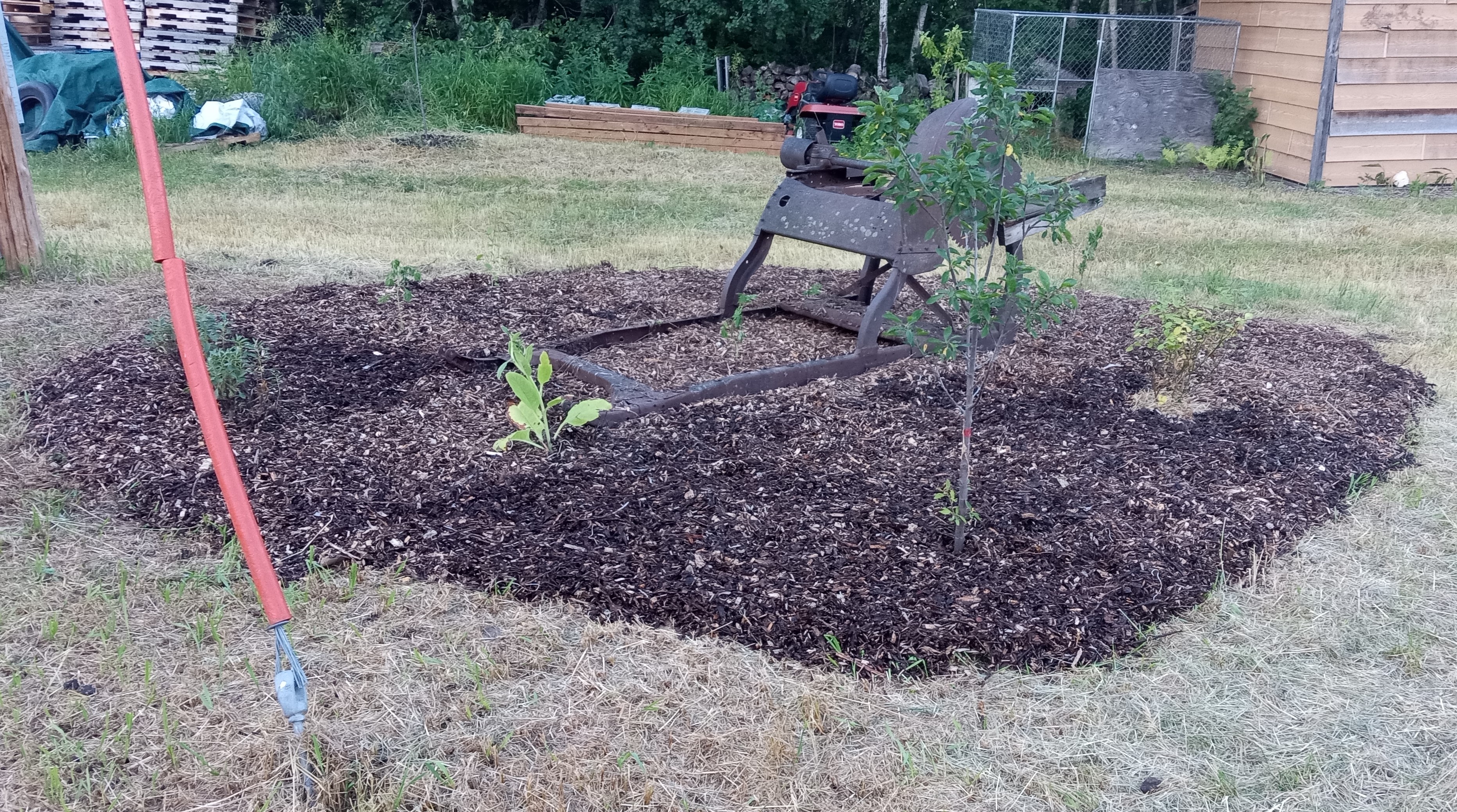
Although there may be some benefits to quackgrass, I still expend a lot of effort to keep quack grass at a dull roar in the gardens. Things like implementing the use of Back to Eden gardening methods as I documented in Achieving a Permaculture Design Principle with the Back to Eden Gardening method,
using homemade landscape fabric as I documented in Woven Landscape Fabric - A Homemade Woven Weed Fabric DIY project
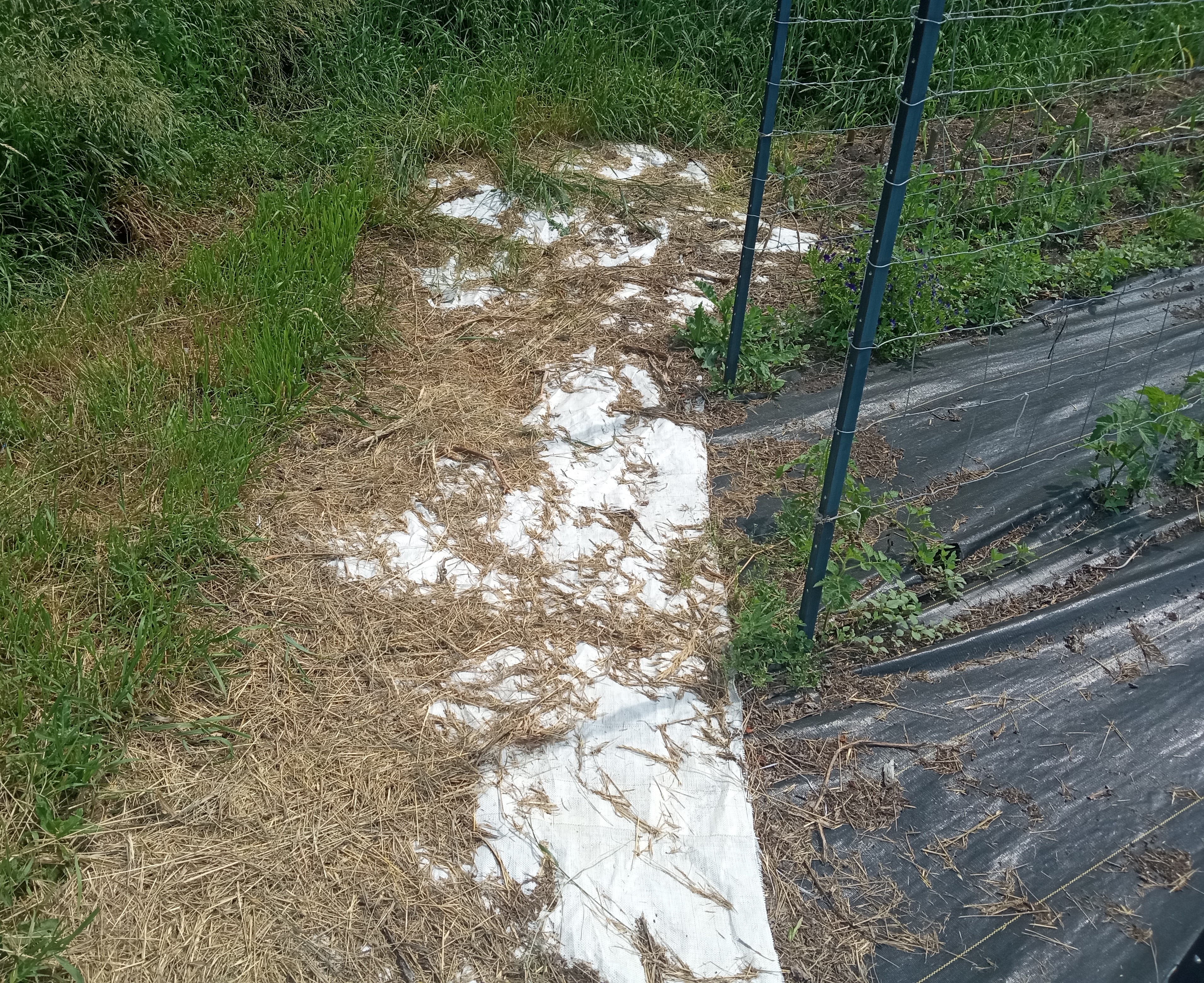
or covering parts of my garden with the DeWitt UltraWeb 3000 - Woven Ground Cover as I discussed in The Tomato Trial - Results of 2023 Tomato Trial and What's New for 2024.
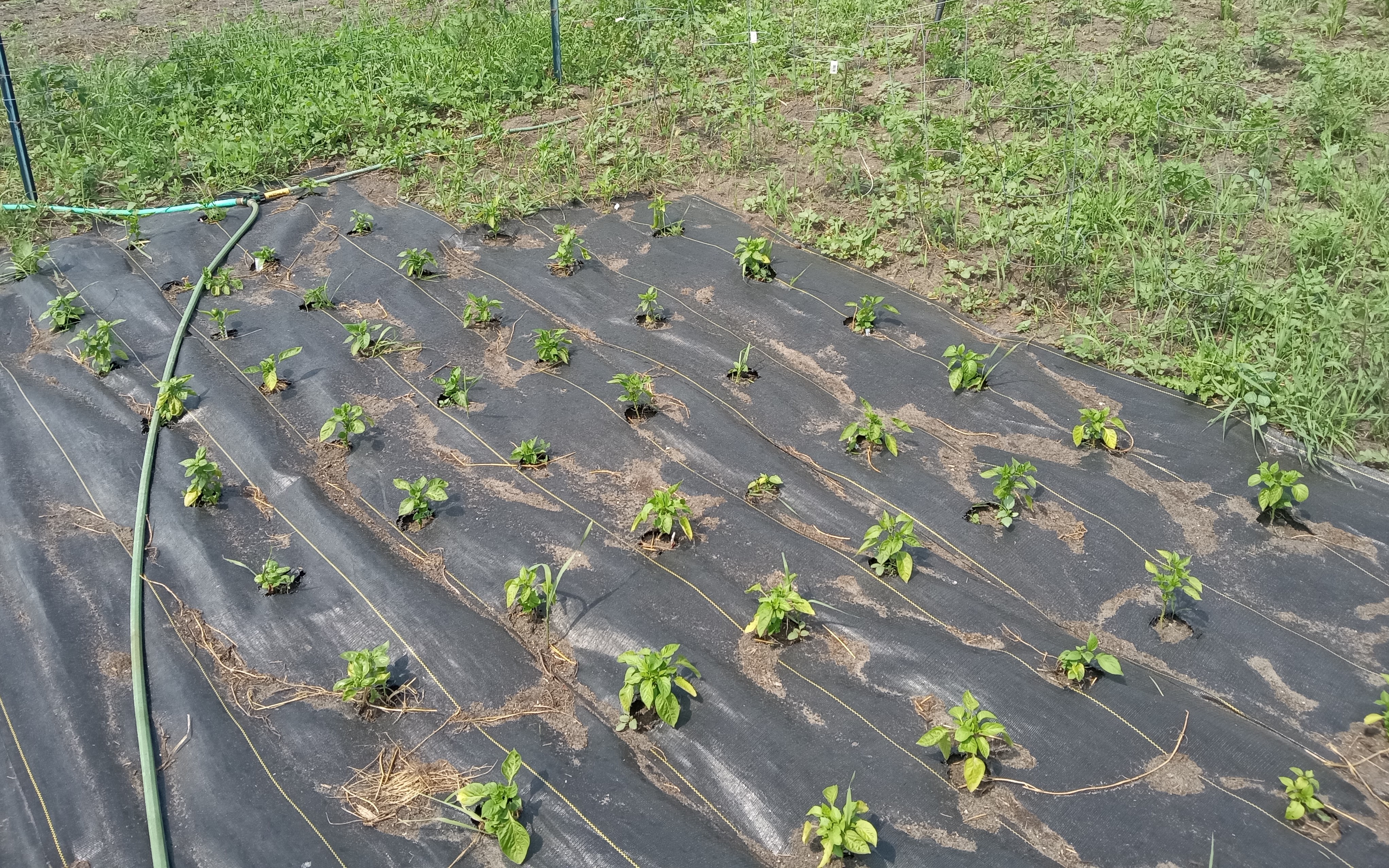
There are still problem areas that I will need to deal with using more of the same non chemical methods I am using now but I think I may also try some other natural methods. Some additional methods I am currently using and/or other methods I may try include, but are not limited to:
- For weeds that spread via rhizomes, if the rhizome can be starved of it's ability to convert sunlight into food for the plant, it will eventually succumb and die. To accomplish this it does take dedicated removal of the leaf as they start to emerge. I have had some promising success by planting potatoes in patches of quackgrass where regular hoeing and hilling is taking place. In combination with close planting of the plants, the foliage eventually forms a canopy that blocks out the sun which does not allow for regrowth of the quackgrass. This personal finding would be supported from the Maine Government in the article Quackgrass (Elytrigia repens) Control Methods in Organic Agriculture where they stated that “As an emergency measure for a plot containing abundant quackgrass, it is better to densely sow seed grain and forage plant seed. To demonstrate the soundness of this practice, an experiment conducted in the Lac St Jean Region over several years found that barley yield in a heavily infested field,14 compared with barley yield in a control plot free of quackgrass, fell by 41% when the seeding rate was 50 kg/ha, but dropped by 19% when the seeding rate was 200 kg/ha.”.
- On a larger scale but applicable to a garden plot, the University of Illinois in summer 1985 in the report titled Quackgrass - A Serious Problem Weed, Vol. 9, Issue 2 that “Tillage practices were once the primary method of quackgrass control, where rhizomes that were brought to the surface by the tillage operation were killed by desiccation. Repeated tillage operations could kill the rhizomes through the exhaustion of their carbohydrate reserves, which were expended in the production of new shoots by the rhizome pieces. However, the additional cultivations must be performed before the new shoots produce rhizomes.”. They further go on to say that “The cultivation process usually must be performed several times in order to control quackgrass.”. The article Quackgrass (Elytrigia repens) Control Methods in Organic Agriculture does suggest that harrowing after each tillage would be recommended so as to gather the rhizomes and dispose of them. However, from a permaculture perspective in which covering the soil is important, this method would perhaps not be something that would be implemented especially if the field was kept baron for a couple years to deal with the quack grass;
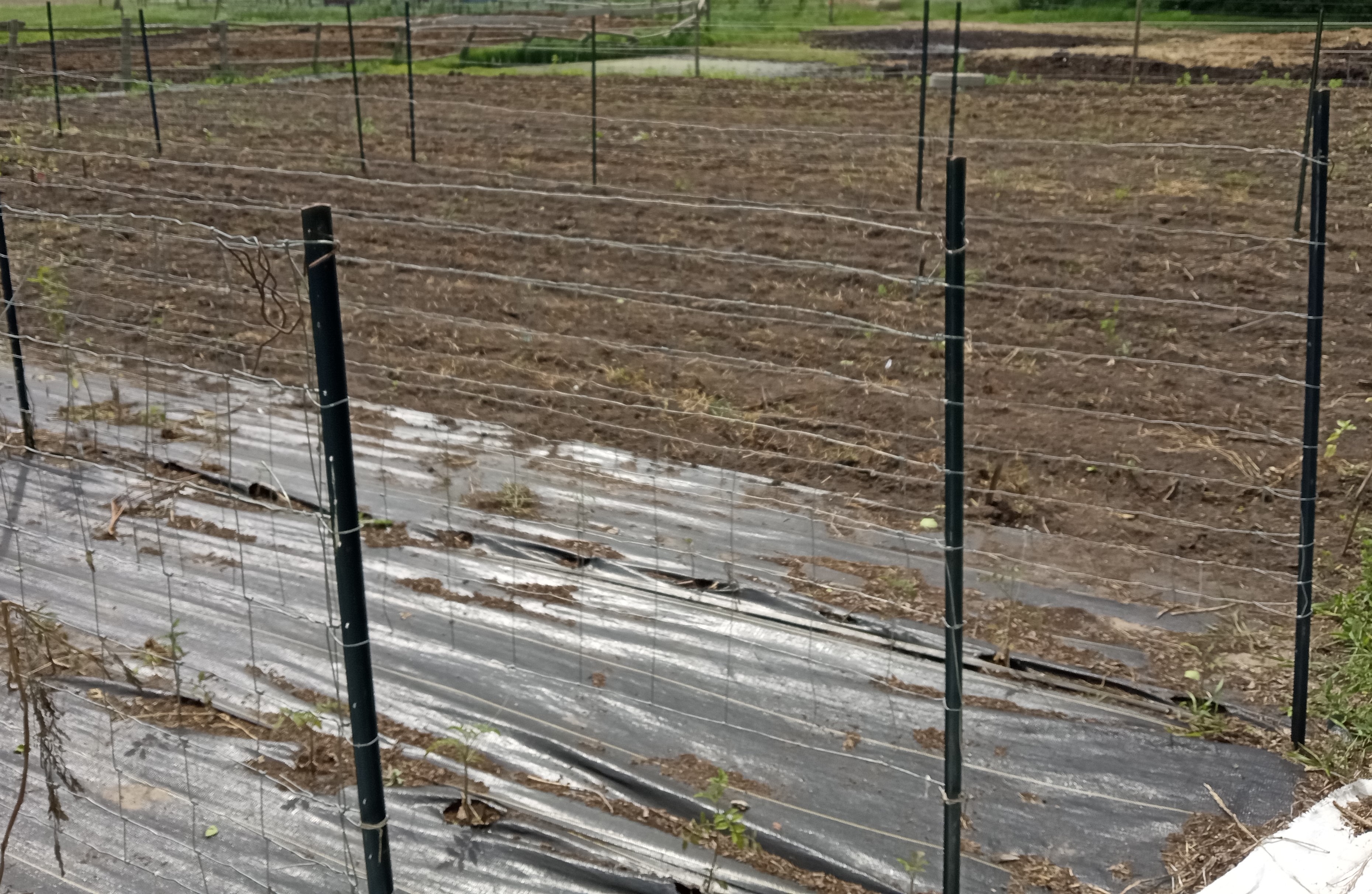
- Smother crops AKA living mulch can be effective at controlling quackgrass, especially if they are fast growing and/or are planted densely. Winter rye, vetch, buckwheat or green feed crops like oats have been shown to help control quackgrass. Studies have shown that planting a thick cover crop boarder around an area is an effective way of preventing quack grass from infiltrating a field or garden. The article Quackgrass (Elytrigia repens) Control Methods in Organic Agriculture suggests that "Quackgrass will often begin its infestation
from the edges of the field, where it has not been destroyed. Other perennial grasses such as orchard grass (Dactylis glomerata) and brome (Bromus inermis) that can effectively compete with quackgrass can be sown all around the field, particularly after resloping or digging of a ditch. ; - Solarization or Occulation - on a small scale, covering the space with a clear plastic sheet or a silage tarp for a period of about four to six weeks, or longer, during the hottest part of the summer can be an effective method of killing quack grass. According to the University of Minnesota article Using the sun to kill weeds and prepare garden plots, both a clear sheet (solarization)and a opaque tarp (Occulation) will work because “occultation is similar to solarization, but opaque coverings are used instead of clear. While it may sound counterintuitive, fields covered in clear plastic become hotter than fields covered in black plastic.” and goes on to say that “Black plastic actually absorbs light, whereas clear plastic allows light and heat to pass through. So occultation takes longer.”. None the less, although both methods have been shown to work, you will want to leave the black plastic sheet in place for a longer time to get a good kill. I have found similar results with my use of the DeWitt UltraWeb 3000 - Woven Ground Cover as I explored in The Tomato Trial - Results of 2023 Tomato Trial and What's New for 2024;
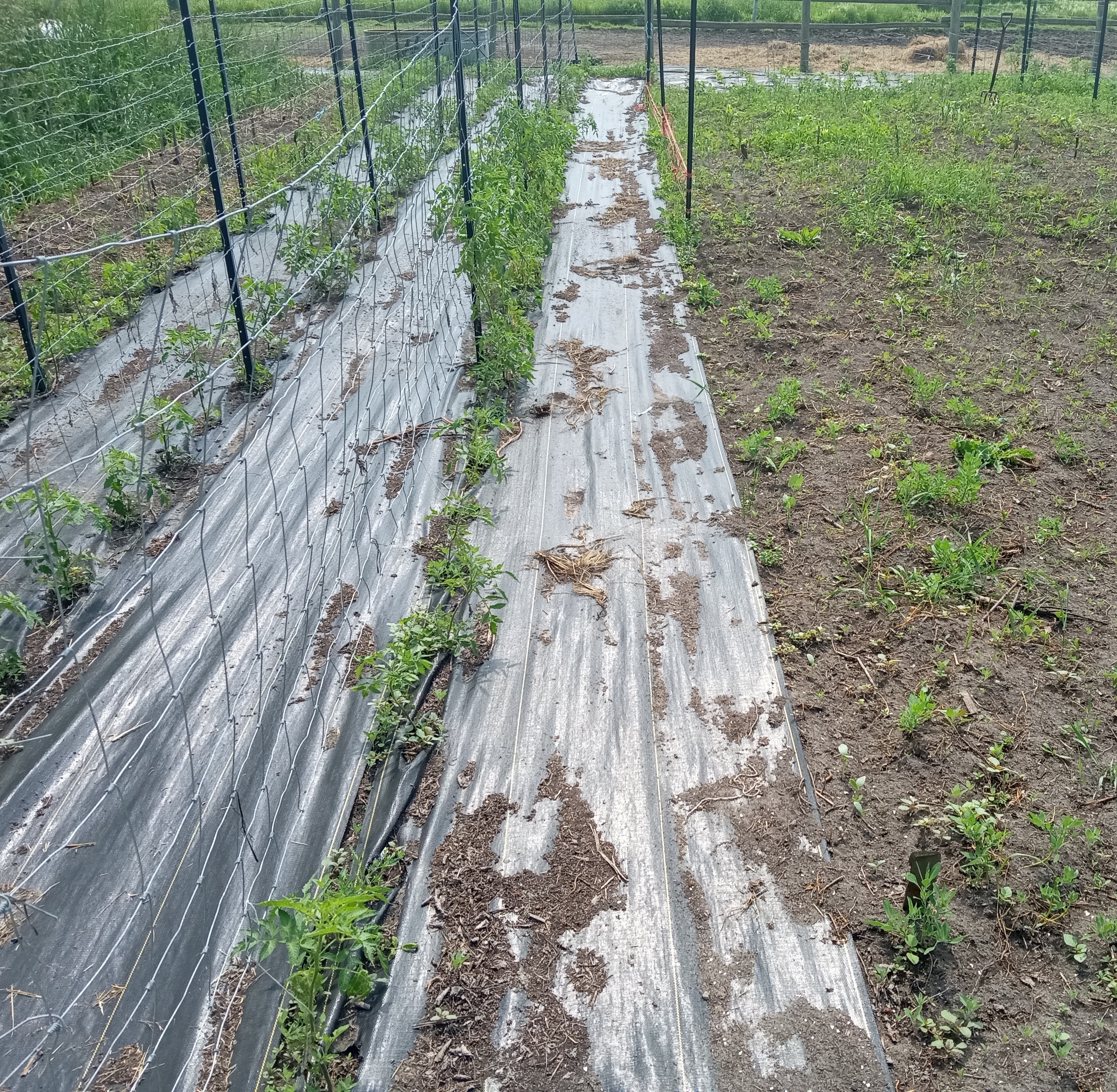
- Controlling of quackgrass in the garden and/or pastures is best summed up by the Manitoba Agriculture department in their article Quackgrass where they state that “ As with some of the other weeds, the keys to control are recognizing the problem and being persistent.”. This persistence, according to the University of Vermont article Quackgrass Management, requires that “Multiple strategies need to be employed in order to successfully manage quackgrass. Of particular importance is well-timed tillage, repeated when re-growth reaches 3 to 4 leaves. Thus, summer fallowing is critical to controlling quackgrass if it is already well-established in a field.”. But in the home garden where fallowing is not possible and/or desirable, persistently removing the green through the use of a Dutch hoe or my new favorite tool from Homestead Iron, the Scuffle Weeder, is certainly something to consider as a tool in the arsenal of “multiple strategies”. I have found it to be helpful;
- Digging it out is most definitely a time consuming operation but is an effective way of controlling quackgrass especially if all the rhizomes are removed and combined with other control methods. However if a rhizome with a node attached is left behind or is broken off, it will start a new plant at each node.
But unfortunately, whether it be on the farm or in the garden, the weapon of choice for the most part to control quackgrass has been Glyphosate based products such as Roundup. Because it is a non-selective herbicide, It makes short work of it and all weeds but as we are now finding out is has been linked to all sorts of medical issues and is ever present in most commercially raised foods and in the environment. Because of it's wide spread use in town and country, drugwatch.com reported in Glyphosate: Health Concerns and Safer Alternatives that “The Environmental Working Group commissioned several rounds of testing in food to detect the chemical. It found glyphosate in 95% of the wheat samples tested. Glyphosate in food and drinking water raises concerns about its potential public impact.”. And with the development of GMO roundup ready plants and the wide spread practice of crop desiccation prior to harvest it has allowed it's use to become even more wide spread and ever more present in the food we consume. Additionally, as I reported in Achieving a Permaculture Design Principle with the Back to Eden Gardening method it is now being found in alarming amounts in water bodies which has been shown to have detrimental affects to aquatic life.
The drugwatch.com article Glyphosate: Health Concerns and Safer Alternatives also reported that “The safe level of glyphosate in food varies based on the food type. The EPA sets the safe range of glyphosate in food from 0.1 parts per million to 400 parts per million, depending on the type of food.” and goes on to say that “Most food safety regulatory bodies say the levels of glyphosate found in food are safe for humans. But some experts question the long-term health effects of continuous exposure to such a potent chemical.”. As I have learned from the Homesteading Family journey with glyphosate toxicity, the long term exposure is of concern as these chemicals are stored in the fat of the body, a defense mechanism to protect the body from these harmful chemicals. Having these chemicals being stored in the body is a concern. As Drugwatch.com reported, “Recent studies suggest potential links, with a 2023 study in Leukemia and Lymphoma finding an increased risk of non-Hodgkin lymphoma because of exposure to certain herbicides like glyphosate. A 2019 study found a 41% increased risk of non-Hodgkin lymphoma with high Roundup exposure.”. They also go on to further state that “ Growing concerns about cancer and other health effects have led some European Union countries to ban glyphosate.”.
In the United States, the Organic & Non-GMO Report reports that “Global usage of glyphosate—3,200 tons per year in 1974—will probably reach 1 million tons by 2020. Usage has driven up the maximum residue limits (MRLs)—between 1993 and 2015, glyphosate MRL increased by 100 percent to 1,000 percent in the U.S., depending on the crop. Levels in oat-containing foods often exceed safe limits.”. They also go on to state that “Glyphosate kills gut bacteria, leading to shifts in the microbiome triggering obesity, Alzheimer’s, or celiac disease. Since herbicides aren’t easily absorbed by the gut, they hang around longer to impact gut bacteria—poor absorption is one reason herbicides are seen as safe to ingest. The toxic additives in commercial herbicides are also not regulated.” It is definitely a point of concern and with the, I dare say, ever increasing current use of glyphosate, one which I have chosen to avoid as much as possible with total avoidance being the goal.
I may be able to avoid a lot of the glyposate by growing my own food and/or voting with my dollar in the store, but quackgrass is admittedly also a pain. But perhaps there are alternatives to using glyphosate that may help with controlling quackgrass. In the drugwatch.com article, Alternatives to Roundup, a number of suggestions are made to deal with a large assortment of weeds, including preemergence control. However, for quackgrass, although they all may be worth a try, the one that sounds the most useful for dealing with quackgrass will be the acid-based herbicides. The most common of which is vinegar which you can buy in 4 - 7% acidity levels, but is also available as Garden Vinegar or Horticulture vinegar which is 20% - 30% acidity. According to the article, “Vinegar’s acidity dries out the surrounding area, shutting off moisture absorption to the plant and killing it". And although it may take multiple applications to destroy the root system, “Scientists from the USDA Agricultural Research Service found that 5% to 10% concentrations of acetic acid successfully killed weeds in their first two weeks of life, while higher concentrations are required to kill all plant stages faster.” It certainly sounds like something worth trying on quackgrass, perhaps in combination with other strategies.
Final Thoughts
In today's Instagram worthy day and age where time saving measures are the norm, the use of glyphosate has become more common place to deal with things like quackgrass and other undesirables. But unfortunately it comes with a cost. It's wide spread use, and the use of other chemicals, has made it so that avoidance of glyphosate can be difficult. Sure I can buy organic and I can raise my own food, but there is still a chance of coming into contact with it as Homesteading family documented in their pantry chat TOXINS & Our Journey to Health (Pantry Chat). It can be found in the air, the water, the food we feed our animals and the food we consume.
There is no argument that glyphosate products make short work of almost instantly eliminating quackgrass and other problematic weeds, but at what cost to my health and the environment around me? As I have explored in other articles, my decision to not engage in the use of glyphosate has been a journey for me that ultimately ended in me not using glyphosate to control quackgrass and other weeds. For me, I prefer to be persistent and use a combination of different eradication methods to deal with the quackgrass and take it down to a dull roar in the gardens. But in the pastures and lawn I welcome it.
And perhaps this is where it requires a mind shift when looking at weeds like quack grass. Do we really need to have the pristine gardens and farms/homesteads free of quack grass? Does a lawn need to be free of quackgrass or is green good enough? Perhaps it does not have to be a total eradication as sold to us by the various companies, only to sacrifice our health and the health of the environment. But rather, perhaps changing to a mindset of slow intentional processes that involves a number of techniques to take it to a dull roar is the better answer. Sure it is a bit more work, giving me exercise, but I feel it is certainly better for my health and the health of the environment by taking that approach. And let's not forget the medicinal benefits and other uses of quackgrass itself. Maybe quackgrass doesn't have to be the nemesis I currently view it as.
Will I let quackgrass go wild in my gardens? Absolutely not. I will continue to work to keep it at a dull roar. But I will do so with the bigger permaculture picture in mind of continuing to work with nature. However, in the lawn and pastures, I will continue to let it do its thing. Nonetheless, I hope you found this exploration into quackgrass, it's benefits and it's control of interest. If nothing else, I hope it has given you some food for thought and encourages you to explore options to supplement and/or replace modern practices. If you did enjoy it, please consider joining the My Boreal Homestead Life community. By supplying your email address at the bottom of the page and hitting "sign up" or by clicking Join the community, you will ensure you get an email notification when I post new blogs to the My Boreal Homestead Life site.
Thank you for joining me on the front porch of My Boreal Homestead Life as we explore this Homegrown, Homestead life, In a Modern World.
A Serious Problem Weed
Additional Resources
- Quack Grass - Journey to Forever
- Quack Grass - Eat The Weeds
- Quackgrass makes excellent forage - Top Crop Manager
- How To Permanently Remove Thistle Weeds. Canada Thistle Removal Plan | Gardening in Canada
- Smothering Rhizomatous Grass with a Tarp (results after A FULL YEAR) - Back to Reality
- These Toxins Are Making You SICK! (Detox Them Naturally) | Pantry Chat - Homesteading Family
- Health Update (I Couldn't Believe The Results) - Melissa K. Norris